TL;DR
Nadukal (“planted stones”) are memorials Tamil communities raised, from at least the 4th century BCE onward, for people who died defending cattle, land, or village against raiders.1 Sangam-era texts describe a formal, multi-stage ritual for turning the stone into an object of worship, and a handful of surviving inscriptions — including one of the oldest Tamil-Brahmi texts ever found — let us read, almost word for word, what the community said about the dead.23 The tradition also quietly encoded who got a stone and who got a temple, which turns out to be a story about rank as much as heroism.4
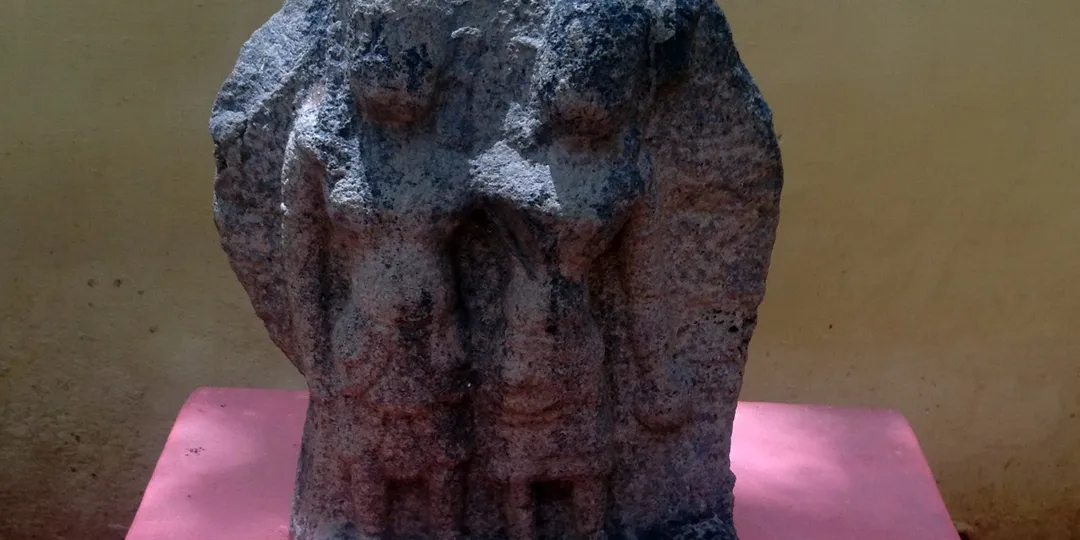
Photo: a hero stone on display at the Tirunelveli Government Museum, photographed by Wikimedia contributor Booradleyp1, shared under CC BY-SA 4.0.5
A Rock That Was Never Just a Rock
Drive through the hill country around Salem, Dharmapuri, or Yercaud and you’ll pass roughly hewn stones standing alone in fields, at tank edges, or under a tree at the edge of a village — easy to mistake for boundary markers or forgotten construction debris.2 They are neither. Each one was, at some point, a funeral, a court record, and a small act of religion-making, compressed into a single slab of granite.
These are nadukal, literally “planted stone,” known elsewhere in the Kannada-speaking world as virakal.1 The custom runs from roughly the Iron Age through the 18th century, with the bulk of surviving stones dating between the 4th and 13th centuries CE — meaning this wasn’t a brief ritual fad, but a memorial practice that outlasted several dynasties.1
What Actually Earned You a Stone
The most common trigger for a nadukal wasn’t dying in a king’s war. It was dying in a cattle raid — a species of low-grade, chronic, local violence that Sangam-era Tamil society clearly took very seriously.14 Hero stones also went up for people killed defending a village against wild animals, and — more rarely — for women who fought, and even for animals: a 939 CE inscription at Atakur, commissioned by a Ganga king, commemorates his hunting dog, killed fighting a wild boar.1
This matters because it tells you the nadukal wasn’t reserved for a warrior aristocracy. It was the memorial format available to an ordinary villager who died doing something the community judged worth remembering. That’s a different, more democratic theory of “heroism” than the one usually associated with ancient monuments.
The Six Steps That Turned Stone Into God
What sets the Tamil tradition apart is how explicitly the process was scripted. A study of hero-stone worship in Sangam literature lays out the consecration in a sequence of named stages: katchi, the search for a suitable stone; kalkol, fixing an auspicious time and formally bringing the stone to the site; nirppadai, ritually bathing it; nadukal itself, the planting; perumpadai, an offering, often of food; and valttu, the final blessing that installed it as an object worthy of praise.3
That’s not folk custom accreting slowly over centuries — it’s closer to a fixed liturgy, the kind of thing you’d expect around a temple consecration, not a roadside memorial. The distance between “war memorial” and “minor deity” that most cultures leave implicit, Sangam Tamil society appears to have made procedural.
What the Stones Actually Say
Most of what’s written above would be folklore if it weren’t for a small number of stones that carry inscriptions. The clearest case is a set of three hero stones found in 2006 at Pulimankombai, a village in the Vaigai river valley in Theni district, plowed up in a farmer’s field.2 Written in Tamil-Brahmi script and dated by specialists to somewhere in the 3rd–2nd century BCE, they’re among the oldest Tamil-Brahmi inscriptions found anywhere.2
One reads, roughly: Kal pedu tiyan antavan kudal ur akol — “this stone, for Pedu Tiyan Antavan, [who died] raiding cattle at Kudal Ur.”2 It names a man, his village, the neighboring village he died raiding, and nothing else — nine words doing the job a modern obituary takes a paragraph to do. This is about as close as archaeology gets to hearing a Sangam-era village speak in its own voice about its own dead.
Further north and later in date, a cluster of memorial stones near Kondaharahalli in Dharmapuri district, dated to the 10th century CE, names a man called Macayya, son of Hocayya, who held a martial title and died in — again — a cattle raid.2 The ruler on record at the time, Sabhatukadeva, carried a stack of grand titles — Pallava-kula-tilaka (“ornament of the Pallava lineage”), Kanchipura-paramesvara (“lord of Kanchipuram”) — that sit oddly next to what he was actually governing: a modest cattle-raiding frontier six kilometres from a village called Bommidi.6 Thirteen centuries and a change of script separate Pulimankombai from Kondaharahalli, and the underlying story — cattle, raid, death, stone — barely moves. Dharmapuri took the pattern seriously enough to build a small museum around it: opened in 1979, purpose-built to hold nothing but hero stones gathered from the surrounding villages, on the reasonable premise that almost every village in the district turned out to have at least one.7
A Frontier That Kept Changing Hands
Zoom out from any single stone and Krishnagiri — split off from Dharmapuri as its own district only in 2004, but part of the same hero-stone country for two thousand years — tells a bigger story than one inscription can.8 In the space of a few centuries, the same stretch of hill country passed through the hands of the Nolambas, then the Cholas, then the Hoysalas, who at one point ran the town of Kundani as a regional capital.8 One stone at Gangavaram is dated by a Chola king’s 25th regnal year; another names a Nolamba ruler; a third belongs to the Hoysala period, two centuries later. Read together, they work less like a war memorial and more like a receipt trail for who controlled this particular patch of frontier, decade by decade.
Most of the people these stones remember are as ordinary as Pedu Tiyan Antavan at Pulimankombai: Aryakutti, a servant killed on a pig hunt; Sekathur Manikkadayanar, another cattle-raid casualty; a man named Kamundan, killed in a dispute over who a particular herd of cattle actually belonged to.8 Small, local, almost bureaucratic deaths — each one still judged worth a permanent stone.
Then there’s a category that has nothing to do with combat at all. At Kundani, and again near the Penneswara temple close to Krishnagiri town, a set of 12th–13th century carvings depict navakandam — literally “nine cuts” — a ritual act of self-sacrifice offered to the goddess Kotravai, rather than a death suffered in a raid.8 One relief shows a man in the act of beheading himself, passing his own severed head to a companion who rides off with it. That’s not a war memorial; it’s a votive one, and it points to a wider, harder-to-verify practice historians refer to as Saktham — sacrificial devotion, not battlefield casualty.8 Whatever we make of it today, it’s a useful corrective to any tidy story that hero stones were purely about martial valor. Some of them memorialize violence a community chose, not violence it merely suffered.
The Line the Stones Quietly Draw
Nadukal weren’t the only memorial architecture in early Tamil Nadu, and the alternative is revealing. Royalty and the upper reaches of the elite got pallipadai — actual memorial temples built over their remains — a categorically different, more permanent, more expensive commemoration than a single inscribed stone in a field.4 Separately, a small number of stones (satikal) commemorate women who died by sati rather than in battle, a distinct and much rarer category that later scholarship has been careful not to conflate with the war-memorial tradition.4 Navakandam stones, discussed above, sit outside this hierarchy in a different way — they’re votive rather than martial, offered rather than suffered, so they cut across rank instead of tracking it.
Stack those three side by side — pallipadai for kings, nadukal for commoners and warriors, satikal for a specific and grim category of women’s deaths — and the memorial landscape of early Tamil Nadu starts to look less like a single unified custom and more like a hierarchy of commemoration, where the size and permanence of your memorial tracked your rank in life. The stones weren’t just remembering the dead. They were quietly re-stating everyone else’s place in the social order while they did it.
The Ritual Wasn’t Just Theory
It’s easy to read a six-stage liturgy off a scholarly summary and assume it describes an ideal that real villages never quite lived up to. Sangam poetry suggests otherwise. Purananuru, the anthology of 400 heroic poems compiled sometime between roughly 200 BCE and 150 CE, doesn’t just mention hero stones in passing — one poem (traditionally numbered 221) describes the hero stone raised for a named figure, the Chola king Koperunchozhan, in enough narrative detail to show that the poets assumed their audience already knew exactly how a nadukal was chosen, planted, and venerated.910 The erection and worship of hero stones turns up across multiple Sangam works — not just Purananuru, but Akananuru, Pattinappalai, Ainkurunuru, and Malaipadukadam as well — which is a lot of independent literary corroboration for what could otherwise look like an antiquarian’s reconstruction.9
The custom of erecting new hero stones ran continuously for roughly two thousand years, through multiple dynasties and scripts, and only tapered off in the early 20th century — not because the underlying impulse to memorialize disappeared, but because photography arrived as a competing, cheaper memorial technology.1 Reading a nadukal today, in other words, isn’t reading a dead ritual. It’s reading the last stretch of a memorial practice that ran almost until living memory, then quietly handed the job to the camera.
Where the Evidence Runs Thin
A few things are worth holding loosely here. Specialists disagree by roughly a century on how to date the Pulimankombai stones — some place the script before the 3rd century BCE, others in the 2nd — which is a reminder that Tamil-Brahmi paleography is still an evolving science, not a settled one.2 Documentation is also lopsided: Karnataka alone has around 2,650 hero stones formally catalogued, a scale of systematic survey that Tamil Nadu’s stones — scattered across private fields, roadside verges, and small district museums — haven’t uniformly received.14 That almost certainly means the Pulimankombai and Kondaharahalli finds are a fraction of what’s actually out there, most of it undocumented, unprotected, and one bulldozer or one monsoon away from disappearing before anyone reads it.
That’s the real stakes of a story like this one. Every hero stone lost to a field being cleared is a nine-word obituary going silent for good — not a myth losing believers, but a fact losing its only witness.
Footnotes
-
https://en.wikipedia.org/wiki/Hero_stone ↩ ↩2 ↩3 ↩4 ↩5 ↩6 ↩7
-
https://tnarchaeology.wordpress.com/category/hero-stones/ ↩ ↩2 ↩3 ↩4 ↩5 ↩6 ↩7
-
https://ia601801.us.archive.org/12/items/worship-of-hero-stone-in-sangam-literature/Worship%20of%20Hero%20stone%20in%20Sangam%20Literature.pdf ↩ ↩2
-
https://expreppro.in/hero-stone-virakal-natukal-explained-upsc/ ↩ ↩2 ↩3 ↩4 ↩5
-
https://commons.wikimedia.org/wiki/File:Tirunelveli_Govt_Museum_Exhibit42.jpg ↩
-
https://storyofkannada.blogspot.com/2012/11/kannada-inscriptions-outside-karnataka.html ↩
-
https://www.tnarch.gov.in/hero-stones-site-museum-dharmapuri ↩
-
https://archive.org/stream/47671/4767-1_djvu.txt ↩ ↩2 ↩3 ↩4 ↩5