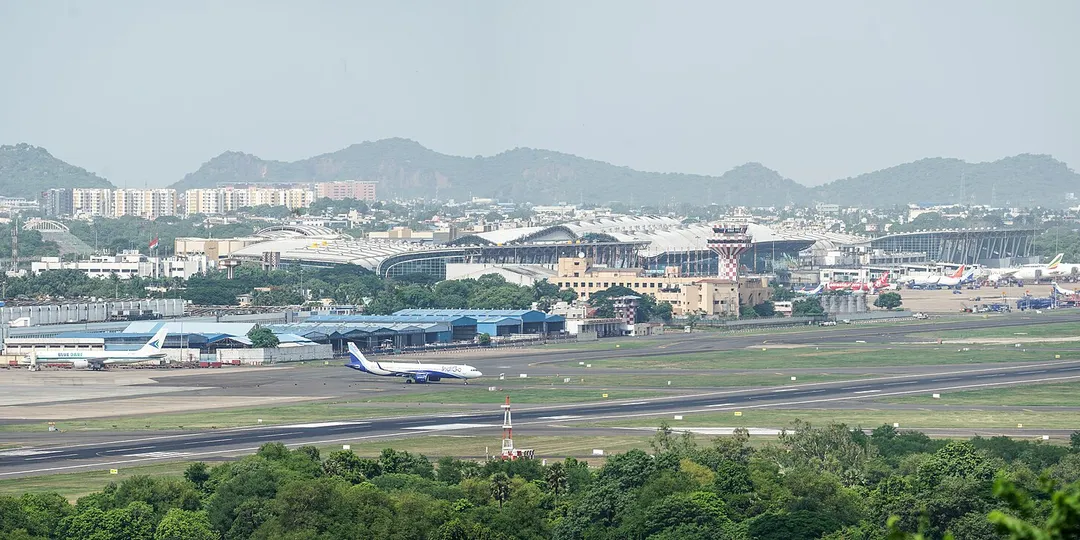
Chennai International Airport seen across runway 07/25. The question is not whether one more terminal can fit, but how much airport the runways can reliably operate. Photo: Timothy A. Gonsalves, CC BY-SA 4.0.1
TL;DR
Parandur was not an irrational choice for Chennai’s second airport. Of the four sites assessed, two had serious airspace conflicts, while Pannur brought more displacement, obstacles, industries and tentative land cost. On those criteria, Parandur had a real case.
But that case was repeatedly enlarged into a claim the evidence did not support: that Parandur was the lowest-risk choice. Its public comparison did not put hydrology, wetland function, earthworks, livelihoods and lifecycle cost on the same footing as aviation suitability. The proposed site was recorded as 63.81% agricultural land and 26.54% irrigation-tank water bodies, and required roughly 72 million cubic metres of net fill.
Expanding Meenambakkam gives Chennai useful time. It does not yet eliminate the case for a second airport. The least-regret strategy is to measure the existing airport’s real runway ceiling while comparing any replacement site against Parandur on the same risks.
The Airport That Was Chosen Twice
Parandur’s first selection happened in 2022, when Tamil Nadu chose it from four candidate sites for a second Chennai airport. Its second, stranger selection happened later: it became the thing every side needed it to be.
For the government that advanced it, Parandur was the technically suitable, future-ready answer to Chennai’s growth. For its opponents, it was an airport imposed on farms, villages and water bodies. For people who wanted more capacity at the existing airport, it became evidence that a second airport was unnecessary. For those who wanted investment spread across Tamil Nadu, it became evidence that Chennai had already received enough.
Then, on 24 August 2026, Chief Minister C. Joseph Vijay’s new TVK-led Tamil Nadu government announced that it would drop the project, look for another site and work with the Airports Authority of India on further expansion at Meenambakkam.23
That decision may sound like a verdict on the evidence. It was not. Cancelling Parandur does not prove that the original aviation analysis was false. Nor does it prove that another site will be safer, that an airport in another city can absorb Chennai’s demand, or that another terminal can overcome Meenambakkam’s runway constraints.
The useful question is narrower: what kind of risk did the Parandur selection actually minimize?
Why Parandur Won the Shortlist
The strongest version of the government’s case begins with airspace, not wetlands.
Tamil Nadu asked AAI to assess Parandur, Pannur, Tiruporur and Padalam. Padalam fell inside the restricted Tambaram local-flying area. Tiruporur sat beside that restriction, close to a firing range and the prohibited zone around Kalpakkam. Their likely runway orientation could also conflict with traffic at the existing Chennai airport.
That left Parandur and Pannur. Here, too, Parandur had measurable advantages. The public selection record said Pannur had extra-high-tension towers, seven industries in or near the site, developed habitations around land needed for navigation aids and fewer acres available within the proposed boundary. It estimated 1,546 displaced families at Pannur against 1,005 at Parandur. Pannur’s tentative land cost was also shown as roughly three times Parandur’s. Parandur sat closer to the Chennai–Bengaluru Expressway and had room for the desired runway orientation.4
This is not a trivial case. Airports are not selected by finding an empty patch on a map. Runway orientation, protected airspace, approach obstacles and contiguous land can eliminate a site before its other virtues matter.
If the claim is “Parandur was the strongest aviation-and-acquisition candidate among these four,” the available record substantially supports it.
The trouble begins when best on the disclosed screen becomes low risk overall.
The Risk That Arrived After Selection
The later project filing describes a landscape that sounds quite unlike land “relatively free of natural obstructions.” That phrase may be true in the specialised language of aviation—few buildings, towers or prohibited zones—and still be badly misleading in ordinary language.
The proposed 2,172.73-hectare footprint was recorded as:
- 47.46% irrigated agricultural land;
- 16.35% dry agricultural land;
- 26.54% irrigation-tank water bodies;
- and the remainder roads, government land and built-up village area.
Agriculture and recorded water bodies together made up 90.35% of the site. The same filing identified two west-to-east water channels, Nelvoy Eri within the footprint and the 201-hectare Parandur lake adjacent to it. It estimated roughly 1,005 affected structures or families and about 36,635 trees.5
There is an important measurement complication. A drone survey in the same report saw only 6% surface water and classified 32% as dry land. This does not necessarily mean one figure is fraudulent. A revenue classification, seasonal surface water and functional flood storage are different measurements. It does mean that quoting whichever percentage helps your side is not hydrology.
The physical transformation was also enormous. The preliminary design reported only about 10,420 cubic metres of cut against 72,053,185 cubic metres of fill: roughly 72 million cubic metres of net fill. It separately listed 47.32 million tonnes of soil as construction material and ₹4,045 crore for site preparation.
The plan was not merely to keep runways away from a lake. It involved raising a vast platform, rerouting northern and southern drainage channels around the airport and redeveloping Nelvoy tank. That creates several linked risks: where the fill comes from, how it is transported, how the ground settles, whether drains remain clear, where displaced water goes and what happens downstream when an extreme storm meets a blocked or partially failed system.
An airport platform can remain dry by sending more water somewhere else. “The runway did not flood” is therefore not the same result as “the project did not worsen flooding.”
Approval Was a Question, Not an Answer
Parandur did receive in-principle approval from the Ministry of Civil Aviation in April 2025. But the approval certificate required environmental and other statutory clearances before pre-development work. It also suggested that Tamil Nadu assess an alternative runway alignment to reduce obstacle-limitation and funnel impacts, and required identified obstacles to be removed.6
This matters because public discussion often treats approvals as interchangeable. They are not.
An aviation authority can conclude that a site is capable of hosting an airport. An environmental Terms of Reference can specify what the impact assessment must study. Neither says that the studies are finished or that the residual risk is acceptable.
The environmental appraisal process asked for catchment-level hydrology, a detailed wetland study and State Wetland Authority clearance, site-sensitivity analysis, social-impact work, tree planning and archaeological assessment.7 Those conditions did not establish that Parandur would fail. They established that the decisive questions were still open.
By the time the project was dropped, I could not find a completed public EIA, public-consultation result or environmental-clearance decision. That supports a precise conclusion: environmental safety had not been demonstrated. It does not support the stronger conclusion that safe mitigation was impossible.
A Thousand Families Are Also Project Risk
The displacement count was one reason Parandur beat Pannur. But “fewer” is not “few.”
TIDCO later sought consultants to plan resettlement sites across roughly 245 acres for about 1,000 families.8 That is not a side programme attached to the airport. It is part of whether the airport can be delivered legitimately and durably.
Compensation can replace an asset at an administratively chosen price. It does not automatically reproduce irrigated livelihoods, access to common resources, neighbour networks, local temples, credit relationships or the knowledge required to farm a particular landscape. Nor does technical compliance manufacture political consent.
The long opposition at Ekanapuram and the eventual cancellation make the mechanism visible. Social legitimacy was not merely an ethical concern outside the project spreadsheet. It was a schedule, litigation, acquisition and political-continuity risk inside it.
This cuts both ways. A government that ignores those costs can destroy a viable project. A government that cancels without resolving acquired land, compensation, restitution and sunk spending can impose a second round of uncertainty on the same people.
Meenambakkam Buys Time, Not Certainty
If Parandur is risky, why not simply keep expanding Chennai International Airport?
There is a serious case for doing more at Meenambakkam. Modernisation raised stated terminal capacity from 23 million passengers annually to 30 million, with Phase II expected to reach 35 million.9 Chennai handled about 22.41 million passengers in 2024–25. That leaves real near-term terminal headroom.10
Recent forecasts also deserve humility. An AAI technical report forecast 23.46 million passengers for 2023–24 and 26.04 million for 2024–25.11 Actual traffic was about 9.6% and 13.9% below those forecasts respectively. Two post-pandemic years do not settle long-run demand, but they make an exact saturation date look less solid than project rhetoric usually suggests.
The constraint is that passengers do not land in terminals. They land on runways.
AAI’s own advisory-committee record described taxiway work expected to lift peak movements from 36 to 45 per hour, while also recording obstacles in the approach to the secondary runway, defence and other land needs, and urban road constraints.12 Meenambakkam’s runways intersect; the airport is embedded in the city; and terminal floor area can grow faster than safe, reliable airside throughput.
The new government has spoken of a fifth terminal and a total capacity of 55 million passengers. But on 25 August, an AAI spokesperson said no technical or traffic study had yet been commissioned, and even the means of moving passengers between terminals remained unresolved.13
So 55 million is currently a terminal concept, not a demonstrated airport-system capacity. Meenambakkam is the obvious bridge. Whether it can be the permanent answer is still one of the missing studies.
Another Site Is Not Yet a Better Site
The cancellation creates a comforting blank space: somewhere else, presumably, is the airport site that keeps Parandur’s airspace and access advantages without its farms, tanks or villages.
Perhaps. But there is no public comparison of a named replacement site yet.
Pannur is the most concrete counterexample. A reported independent GIS analysis argued that it had fewer and smaller water bodies and might require less filling than Parandur.14 That is worth testing. The underlying model was not available for this investigation, and the claim must still be weighed against Pannur’s documented displacement, towers, industries, land-extension needs and tentative cost.
The same discipline applies to moving the airport to another Tamil Nadu city. Improving Coimbatore, Tiruchirappalli, Madurai, Salem, Thoothukudi or a future Hosur airport may be excellent regional policy. It does not move a Chennai-bound passenger’s home, office, supplier or customer. Airport capacity is not inventory that can be reassigned between towns without changing the trip.
Regional airports are complements unless origin-destination and catchment evidence shows how much Chennai demand can genuinely move. Counting their empty terminal space as spare Chennai capacity answers the wrong question.
The Least-Regret Sequence
There is no honest single winner in the present evidence. There is, however, a better order of decisions.
First, complete and operationally validate the 30-to-35-million-passenger programme at Meenambakkam. Remove feasible obstacles and improve taxiways and access where the benefit is clear.
Second, commission an independent capacity study that reports runway movements, peak-hour delay, resilience when a runway is unavailable and the airside implications of a fifth terminal. “Passengers per year” should be an output, not an architectural promise.
Third, compare every greenfield candidate—including Parandur as the benchmark—on the same public criteria: aviation safety, basin-level extreme-rainfall hydrology, wetland function, fill and ground stability, displacement and consent, access cost, lifecycle cost and delivery time.
The proposed Parandur metro illustrates why this must be a system comparison. In 2024, Chennai Metro Rail was only commissioning a detailed project report for a 43.63-kilometre extension from Poonamallee, with roughly 19 stations.15 A distant airport’s access line is not an optional extra. It is part of the airport’s cost, usefulness and carbon footprint.
Finally, set trigger points. If Meenambakkam can reliably operate near 55 million passengers and demand remains below that level well into the 2040s, preserve a future site and wait. If its usable ceiling is closer to 35 or 45 million and demand will cross it before a new airport can open, expansion and greenfield development must proceed together. If a replacement materially lowers hydrological and social risk without severe airspace or access penalties, choose it. If none does and a redesigned Parandur passes independent review, Parandur may remain the least-bad option.
This is slower than announcing a winner. It is faster than choosing the wrong one twice.
The Strongest Case for Parandur
The strongest challenge to this argument is that large infrastructure cannot be built without changing land, and no Chennai-region site will be free of farms, settlements, drainage or opposition. Parandur involved no forest land and no protected or eco-sensitive area within the project’s cited ten-kilometre screen. Its designers did propose replacement drainage and water-storage measures. Pannur’s documented disadvantages were real.
That is enough to reject the easy slogan that Parandur was obviously impossible. It is not enough to certify the opposite.
The relevant comparison is not Parandur against an imaginary zero-impact airport. It is Parandur’s residual risk after credible mitigation against the residual risk of feasible alternatives—including the cost of delay. The problem is that this comparison was not available publicly when the project acquired political momentum.
Where I’d Hold This Loosely
The full March 2022 AAI alternatives report was not publicly available to this investigation. Its short justification may omit work that would make the selection more comprehensive than it appears.
The state’s expert hydrology report was also not available. Independent flood critiques raised serious mechanisms, but their full inputs and reproducible models could not be inspected. Unresolved risk is not the same as measured disaster.
Meenambakkam’s ultimate runway capacity remains unknown. The fifth-terminal proposal could survive serious study, or fail it. That answer would materially change how urgently Chennai needs a greenfield airport.
And no replacement site has been named and compared. It is therefore too early to say the 2026 reversal produced a safer plan rather than merely reopening the search.
What the Choice Actually Proved
Parandur’s selection proved something useful but limited: among four screened sites, it solved several hard aviation and acquisition problems better than its rivals.
It did not prove that its water landscape could be transformed safely, that 72 million cubic metres of fill was a minor engineering detail, or that a thousand displaced families were simply a lower number in a comparison table. Its cancellation did not prove those problems were insoluble. And a fifth terminal at Meenambakkam does not prove Chennai can avoid the greenfield decision forever.
The durable lesson is not that airports should never be built on contested land. It is that the criteria used to choose a site determine which risks become visible—and which arrive later, after “best” has already hardened into “inevitable.”
Footnotes
-
https://commons.wikimedia.org/wiki/File:Panorama_Chennai_Airport_Runway_0725_Aug22_A7C_02299-Pano-2.jpg ↩
-
https://newsonair.gov.in/tamil-nadu-cm-c-joseph-vijay-announces-dropping-of-parandur-greenfield-airport-project/ ↩
-
https://english.publictv.in/tn-cm-vijay-announces-that-tvk-govt-will-abandon-plans-to-set-up-new-airport-in-parandur/ ↩
-
https://s3.ap-south-1.amazonaws.com/media.thesouthfirst.com/wp-content/uploads/2024/09/New-Doc-11-24-2023-11.53-1_compressed-1.pdf ↩
-
https://data.opencity.in/dataset/chennai-greenfield-airport-at-parandur-documents ↩
-
https://www.civilaviation.gov.in/sites/default/files/2025-06/Parandur%20In-Principle%20Approval.pdf ↩
-
https://www.newindianexpress.com/states/tamil-nadu/2024/Jul/31/panel-suggests-issuing-tor-for-environ-impact-assessment-for-parandur-airport ↩
-
https://tidco.com/wp-content/uploads/2024/09/RFP_for_Preparation_of_Mater_Plan_Provding_Design_and_PMC.pdf ↩
-
https://www.pib.gov.in/PressReleasePage.aspx?PRID=2114569&lang=2®=48 ↩
-
https://www.aai.aero/system/files_force/tender/NIT49SQM28102024.pdf?download=1 ↩
-
https://www.aai.aero/sites/default/files/Approved_noise_mapping_report_of_chennai_Airport.pdf ↩
-
https://www.aai.aero/sites/default/files/AAC%20Meeting%20MAAPRE18032023.pdf ↩
-
https://www.newindianexpress.com/amp/story/cities/chennai/2026/Aug/25/chennai-airport-to-get-fifth-terminal-between-two-runways ↩
-
https://www.thenewsminute.com/amp/story/tamil-nadu/proposed-airport-site-in-parandur-flood-prone-says-gis-study-pannur-better-option ↩
-
https://chennaimetrorail.org/wp-content/uploads/2024/07/Press-Release-26.07.2024-English.pdf ↩