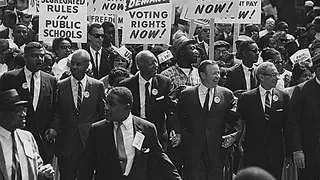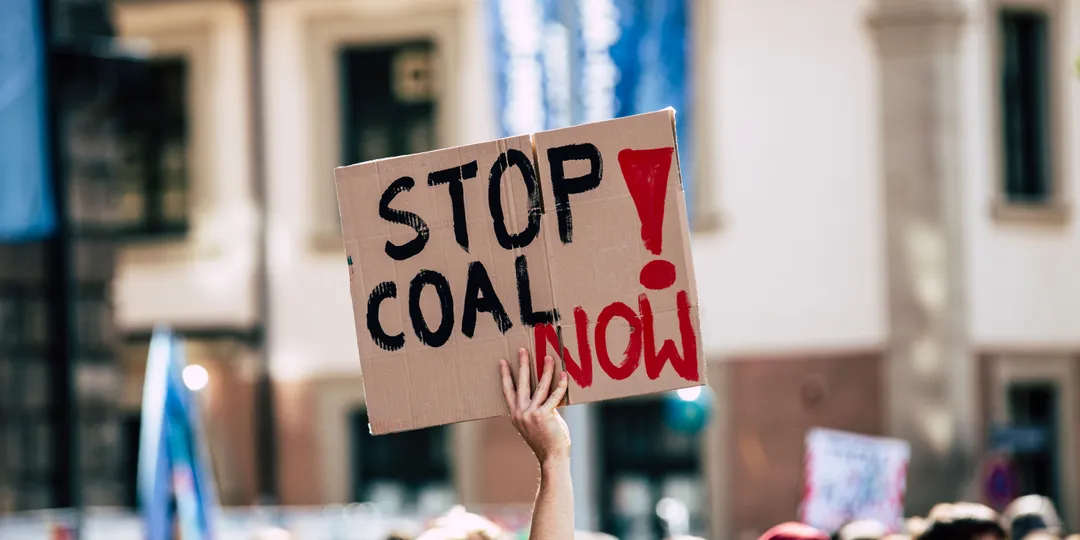
One sign can become the visible voice of an entire crowd. Photo: Markus Spiske on Pexels.1
TL;DR
A movement’s average position can shift even when most of its members do not. If people who feel increasingly out of place are more likely to leave, the remaining group becomes more homogeneous by selection. Like-minded discussion can then move individual opinions, status competition can reward harder moral language, and social platforms can reinforce the expressions that attract approval. But this is a mechanism, not a verdict: movements also radicalize in response to repression, new evidence and genuine injustice, while radical flanks can sometimes make moderates look more reasonable.
A Group Average Can Move Without Everyone Moving
Imagine a room containing ten people, arranged from cautious reformers to uncompromising radicals. Nobody changes their mind. Then the three most cautious people walk out.
The room is now more radical on average.
That sounds almost too simple to matter. Yet public explanations of political radicalization regularly skip over it. We picture a stable set of people being persuaded, corrupted or pushed toward an extreme. Sometimes that happens. But a collective is not a fixed person. It is a changing population. Its apparent beliefs depend on who joins, who speaks, who stays and who quietly decides that the room is no longer theirs.
This distinction separates individual radicalization from compositional radicalization. In the first, the same people become more extreme. In the second, the mix of people changes. From outside, both produce the same photograph: a movement that looks narrower, harsher and more certain than it did before.
The photograph cannot tell us which process produced it.
Exit Is Also an Editorial Decision
Leaving a group does more than subtract one body. It removes a viewpoint from the group’s future arguments, votes, leadership contests and informal sense of what a normal member believes.
Research on political parties gives us a clean demonstration. A survey of more than 10,000 members across seven Swedish parties found that ideological incongruence was associated with a greater probability of voting for another party or leaving the current one.2 British party-member research points in the same direction: people who reported growing ideologically distant from their parties were more likely to quit, and ideological disagreement was the main reason former members gave for doing so.3
Neither study proves that social movements inevitably purge their moderates. Political parties are not feminist organizations, anti-caste coalitions or civil-rights campaigns. The direction also matters: the person leaving may be more radical than the organization, not more moderate. What the evidence establishes is the selection mechanism. Ideological mismatch predicts exit, and exit changes who remains.
This makes departure an unintentional form of editing. The people most uncomfortable with the emerging line become less likely to attend the next meeting. Their absence makes the line look more consensual. Newcomers encounter that narrower consensus and sort themselves accordingly. A position that was contested internally can eventually appear foundational, even if it became dominant partly because its dissenters stopped showing up.
No conspiracy is required. Nobody has to announce a purge. Ordinary decisions about whether participation is still worth the social and emotional cost can slowly rewrite the group.
The Remaining Room Can Then Move
Selection is not the whole story, because the people left in the room still influence one another.
An experiment involving like-minded discussion groups divided participants according to their attitudes toward a linguistic minority. Unstructured discussion pushed the groups toward greater polarization. When researchers introduced deliberative norms, the polarizing effect was avoided.4 The finding matters because it shows that homogeneity is not destiny. The rules of discussion can change what a like-minded group does with its agreement.
Without those rules, members hear more arguments supporting the direction they already favour. They also learn where the group’s centre of gravity lies. A participant who privately holds a qualified position may discover that certainty earns approval while qualification produces suspicion. The pressure need not take the form of explicit censorship. People are skilled at noticing what receives warmth, silence or correction.
This creates a loop:
- ideological mismatch makes some members more likely to leave;
- the remaining group becomes more homogeneous;
- homogeneous discussion can move the remaining members further;
- the new position creates fresh mismatch for whoever is now at the moderate edge.
The movement did move after all—but selection may have prepared the room in which persuasion became easier.
Moral Language Can Become a Status Ladder
Movements do not only distribute ideas. They distribute attention, trust, influence and belonging. Those are forms of status, even inside groups explicitly committed to equality.
Research on moral grandstanding distinguishes two status routes: seeking prestige by appearing admirable and seeking dominance by forcefully asserting rank over others. Across a series of studies, self-reported grandstanding motives were associated with status seeking, political or moral conflict, and polarizing behaviour. The authors were careful to call the evidence preliminary, and the measure concerns motivation rather than the truth of any moral claim.5
That last distinction is essential. A person can make an accurate accusation for status. Another can make the same accusation from sincere concern. We cannot diagnose motive from the sentence alone.
At the group level, however, the incentive can still matter. If moral vigilance earns recognition, members have a reason to identify a violation others missed. Once an obvious injustice has already been named, distinction comes from detecting a subtler one, demanding a stronger remedy or treating yesterday’s adequate language as today’s evidence of complicity. The content may remain morally serious while the competition around it encourages escalation.
Formal models of mass movements show a related signaling problem. When citizens cannot directly observe how severe a situation is, leaders may use the radicalism of a proposal to signal that severe reform is necessary. But radical leaders also have an incentive to exaggerate, so credible signaling can require an even more radical proposal—despite reducing the movement’s chance of success.6 The model does not prove that real leaders consciously behave this way. It identifies a strategic pressure: extremity can function as evidence of commitment precisely because it is costly.
Platforms Turn Approval Into Training Data
Offline groups communicate approval through applause, invitations, deference and promotion. Online platforms make the rewards immediate and countable.
A study of 7,331 Twitter users and 12.7 million tweets, paired with two preregistered behavioural experiments, found that positive feedback for expressions of moral outrage increased the likelihood of future outrage expression. Users also adapted to the expressive norms of their networks. In ideologically extreme networks, visible norms mattered more than the feedback attached to any single post.7
This does not show that social media invents moral outrage or that outrage is irrational. It shows a learning process. Platforms repeatedly display which emotional performances receive social reward, and users adjust.
That mechanism also changes who appears to represent a movement. A patient organizer doing unglamorous coalition work may be central offline and nearly invisible online. A participant skilled at producing condemnations may attract a far larger audience. Observers then mistake the movement’s most rewarded content for its full membership. What looks like organizational radicalization may partly be visibility selection: the platform amplifies a particular voice, and the audience infers a collective position from it.
The Thesis Is Strongest Where It Is Narrow
“The moderates left” is an attractive explanation because it can flatter every outsider. It allows a former member to conclude that the cause deteriorated while they remained reasonable. It allows opponents to dismiss uncomfortable demands as the work of fanatics. Used carelessly, it becomes a story that cannot lose.
The evidence does not justify that story.
First, ideological exit has no guaranteed direction. Radicals also leave organizations they consider timid, captured or compromised. A movement can moderate through exactly the same selection mechanism.
Second, escalation is not always internally generated. Repression, failed negotiations, newly visible harms and changing political opportunities can rationally alter a movement’s goals or tactics. A position that appears extreme relative to yesterday’s consensus may be a proportionate response to evidence the earlier consensus ignored.
Third, radical factions are not simply parasites on successful movements. In two experiments involving animal-rights and climate activism, exposure to a faction using radical tactics increased support for a moderate faction in the same movement by making the moderate group appear less radical. The authors found a positive contrast effect, not proof that radical tactics always help.8
Finally, “moderate” describes a position relative to a group, not its moral quality. Abolitionists were radical relative to societies organized around slavery. Equal citizenship has repeatedly been condemned as excessive by institutions invested in inequality. A centre point can be stable and still be wrong.
Ask Who Changed, Who Left and Who Became Visible
When a movement appears to have hardened, asking whether it “went too far” bundles several different questions together.
Did the same members change their beliefs? Did ideologically mismatched members leave? Did newcomers enter with different views? Did internal rules reward certainty over deliberation? Did leaders use radical proposals to signal commitment? Did a platform make its most confrontational participants disproportionately visible? Did external events genuinely justify a stronger position?
Those questions produce different explanations and demand different evidence. Membership records can reveal turnover. Panel surveys can track individual belief change. Meeting rules can explain whether dissent remains speakable. Platform data can separate organizational influence from online visibility. Historical evidence can show whether repression or political failure preceded escalation.
The useful conclusion is not that emancipatory movements secretly become cults, or that structural analysis inevitably turns people into permanent oppressors and victims. It is simpler and less comforting: a movement’s public ideology is partly the product of population dynamics and reward systems. Principles matter, but so do the mechanisms determining which principled people remain in the room—and which of them receive the microphone.
Footnotes
-
https://www.pexels.com/photo/climate-road-landscape-people-2990657/ ↩
-
https://portal.research.lu.se/en/publications/emancipated-party-members-examining-ideological-incongruence-with/ ↩
-
https://journals.plos.org/plosone/article?id=10.1371/journal.pone.0223749 ↩
-
https://www.cambridge.org/core/journals/american-political-science-review/article/radicalism-in-mass-movements-asymmetric-information-and-endogenous-leadership/99779526744B0D1196BC1F8A84A7A764 ↩
-
https://collaborate.princeton.edu/en/publications/how-social-learning-amplifies-moral-outrage-expression-in-online-/ ↩
-
https://academic.oup.com/pnasnexus/article/1/3/pgac110/6633666 ↩