Editorial update, September 19, 2026: The earlier “mostly harmless” subtitle was too broad. The framing now distinguishes a survey threshold from evidence about harm and keeps the Hungarian findings within their population. For the separate question of when admiration changes our standards of judgment, see The Celebrity Exception.
TL;DR
Celebrity-worship scales measure degrees of involvement. In a representative Hungarian sample of 2,028 adults aged 18–64, 4.53% met the study’s high-admiration threshold, rising to 8.51% among those aged 18–34.1 These figures neither measure Tamil audiences nor establish that everyone below the threshold is unaffected by harm. Higher involvement has been associated with several poorer mental-health outcomes.2 The Tamil Nadu question here is organizational: how fan associations helped turn film fame into political mobilization. That account does not require assuming that Tamil fans are psychologically identical to, or different from, audiences elsewhere.
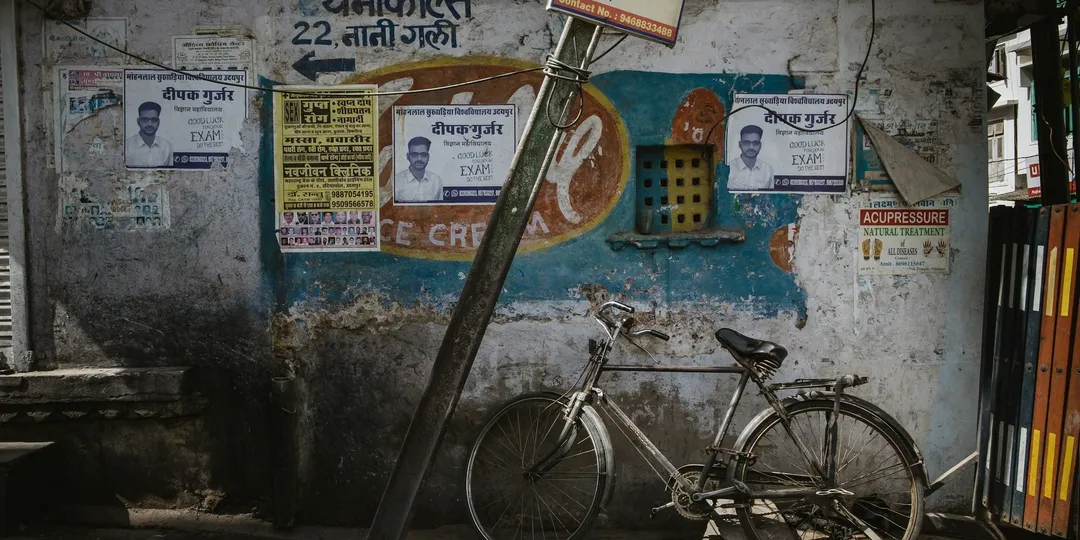
The wall is the medium. Fame turns political the moment somebody organises the people looking at it. Photo: Andrew Schultz on Unsplash.3
A Scale, Not a Slur
“Celebrity worship” sounds like a term of abuse, which obscures the fact that it’s an operationalised construct with a validated instrument behind it. The Celebrity Attitude Scale measures attitudes toward a person’s favourite celebrity across three ascending levels:2
- Entertainment-Social — following a celebrity because they’re entertaining, and enjoying talking about them with others.
- Intense-Personal — obsessive and compulsive attitudes, a felt personal bond with someone you’ve never met.
- Borderline-Pathological — attitudes and behaviours that have become genuinely dysfunctional.
The research frames this explicitly as a continuum ranging from normal admiration to the psychopathological, with casual fandom occupying the normative end.2 That framing matters, because the popular version of this conversation treats any strong fan attachment as a symptom, and the instrument itself says otherwise.
How Common Is the Bad Kind?
Until recently, most celebrity-worship research relied on student samples and members of specific fan communities — populations selected, in effect, for having the trait being studied. A Hungarian study using computer-assisted personal interviewing with a representative sample of 2,028 adults aged 18–64 changed that, and reported the first prevalence estimates from a general population.1
In that Hungarian population, 4.53% met the high-admiration threshold, compared with 8.51% among those aged 18–34.1 Most respondents fell below that threshold. A threshold for intense admiration is not a measure of every possible harm.
The correlates of the high-intensity group are consistent and worth stating plainly. They were younger (mean 32.35 vs 37.09 years), less educated (24.35% with only primary schooling against 15.04%), and more likely to report symptoms of problematic internet use, depression, anxiety and stress.1 The clinical literature adds more: higher worship levels associate with poorer mental health, elevated somatic symptoms and social dysfunction, reduced life satisfaction, and — at the top end — fantasy proneness and dissociation, which show no such association at low levels.2 In adolescents aged 14–16, moderate celebrity worship has been linked to body-image concerns and greater likelihood of pursuing cosmetic surgery.2
These associations warrant attention without making enjoyment a diagnosis or establishing whether distress is a cause or a consequence of intense involvement.
What Tamil Nadu Actually Did Differently
Here’s where the psychology stops being the interesting variable.
I could not establish from comparable population data whether Tamil audiences experience more or less intense attachment than audiences elsewhere. The organizational question can be examined without assuming a psychological equivalence.
M. G. Ramachandran acted in over 135 films across five decades and became one of Tamil cinema’s biggest stars.4 His political ascent inside the DMK, which he joined in 1953, ran explicitly on that fame — he rose through the party’s ranks on the strength of his popularity as a film star, despite limited administrative experience.4 After his expulsion in 1972 he founded the AIADMK, and crucially he kept acting, using cinema itself as a medium to carry political messages.4 In 1977 the party took 144 of 234 seats.4 By 1984, with MGR seriously ill, widely published photographs of him recuperating in hospital generated a sympathy wave that carried the election.4
That last detail is the tell. An electorate responding to images of a leader’s body — not his policy, record, or coalition — is an electorate relating to a screen persona. And the persona was built deliberately: heroic, anti-establishment characters whose audiences transferred their emotional investment from the films to the ballot.4
The comparison with the US is useful here as an organizational contrast, not as evidence of psychological equivalence. America has repeatedly elected performers, but the conversion route runs through individual name recognition and media saturation — a famous person becomes a candidate. In Tamil Nadu the route ran through organisations: fan associations with local chapters, officers, welfare activities and meeting calendars, which could be re-pointed at electoral work. One is a celebrity acquiring a campaign. The other is a fan network acquiring a manifesto.
Why the Structural Version Is More Durable
This distinction predicts something the purely psychological account can’t: why the Tamil pattern reproduces across generations while individual celebrity candidacies elsewhere mostly don’t.
A fan club that already runs neighbourhood welfare activity and celebrates a star’s birthday at scale is, functionally, a ward-level political organisation that hasn’t declared itself yet. It has membership lists, hierarchy, local credibility, and practice at turning people out. Converting it costs far less than building a party from nothing — which is why the lineage from MGR onward keeps recurring rather than remaining a one-off.
It also explains why the model doesn’t reliably transfer. Fame alone doesn’t produce it; you need the intermediate layer. A star with enormous box-office draw and no organised fan structure has an audience, not a cadre, and audiences do not canvass.
Where I’d Hold This Loosely
Several genuine limits, and one of them is significant.
The prevalence figures are Hungarian. A 4.53% high-admiration rate there cannot be transferred to Tamil Nadu, and this essay has no comparable representative Indian estimate. Nor does an absence of demonstrated psychological difference establish equivalence. The organizational interpretation stands as a separate argument; direct cross-national comparisons could change how much weight it deserves.
Second, the mental-health correlations are correlational. Distress may drive intense fandom as readily as the reverse, and the association with problematic internet use suggests a shared vulnerability rather than a clean causal path.
Third, treating fan-club politics as simple irrationality is too easy, and worth resisting. Those organisations did real distributive work — welfare activity, local advocacy, access to people otherwise unreachable by the state. A voter backing a star whose network actually helped their neighbourhood is not obviously less rational than one voting on a manifesto they never read. The critique that lands isn’t “these voters are dupes.” It’s narrower: loyalty to a screen persona is a poor instrument for evaluating governance, because the persona is designed, and it was designed by people who also wanted your vote.