TL;DR
Young people do not universally proceed under an illusion of immortality. In two US samples, adolescents greatly overestimated their chance of dying, and estimates were highest among those reporting threats such as unsafe neighbourhoods.1 In longitudinal data, expecting an early death predicted lower educational attainment and earnings years later even after several background factors were controlled.2 Yet a limited horizon can produce the opposite response: experiments that made an ending salient caused younger adults to prefer emotionally meaningful relationships, while an imagined twenty-year extension of life made older adults more exploratory.3 Fragility is therefore not a teacher with one lesson. Finitude with agency can concentrate a life; finitude without agency can contract it.
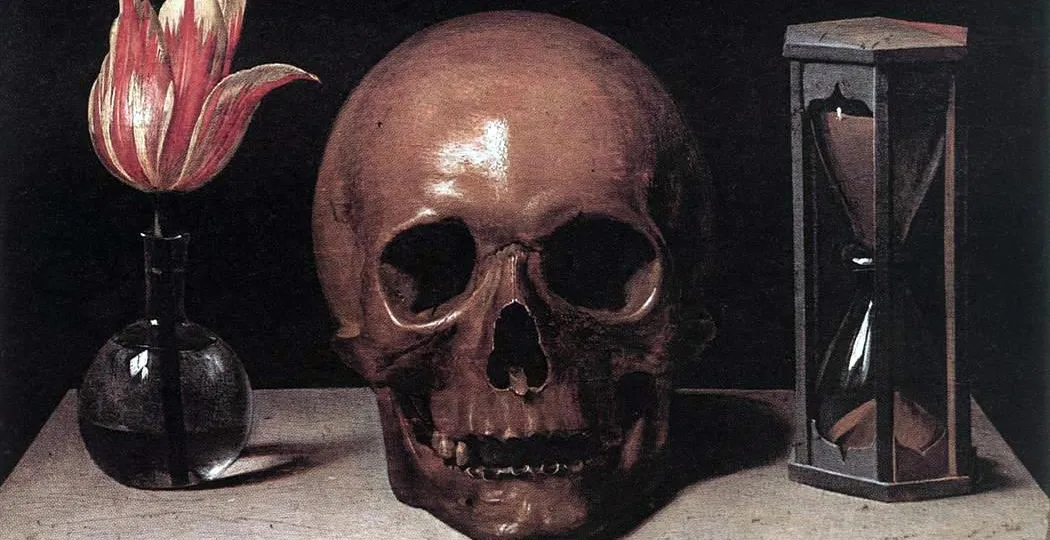
Bloom, death and time, all occupying the same table. Philippe de Champaigne’s 1646 Vanitas is in the public domain.4
The Young Are Not Waiting to Discover Mortality
The familiar story has a cinematic neatness to it. Youth feels immortal, so it explores, takes risks and postpones the serious work of attachment. Age brings illness and loss; mortality finally becomes real; conquest gives way to connection. The arc is attractive because it turns ageing into moral progress.
The evidence breaks the opening scene.
In a nationally representative sample of 3,436 Americans aged fourteen to eighteen, and a separate regional sample of 256 younger adolescents, respondents greatly overestimated their risk of dying. The national data behind the study had fifteen- and sixteen-year-olds assigning an average 18.6% chance to dying in the next year, against a statistical mortality rate of 0.08%. Those reporting direct threats, including unsafe neighbourhoods, gave higher estimates.1
This was not a small correction to the idea of youthful invulnerability. It ran in the other direction. The authors concluded that, contrary to folk wisdom, the adolescents they studied displayed an exaggerated sense of mortality—and that the exaggeration was greatest among those whose surroundings supplied more reasons to feel threatened.1
Nor was the expectation inert. A longitudinal analysis following participants from the US National Longitudinal Study of Adolescent to Adult Health found that low perceived chances of surviving to thirty-five predicted lower education and personal earnings in adulthood, including in models controlling for family socioeconomic status, demographics and depressive symptoms.2 The authors correctly stop short of declaring simple causation: low survival expectations may partly register a genuinely worse life trajectory. But the practical logic is hard to miss. If you are unsure you will live to collect the return, studying, training and protecting future health become less compelling investments.
The ability to treat tomorrow as abundant is not merely a property of being young. It is partly an achievement of safety. Invincibility is a luxury.
A Closing Restaurant Is Not a Building on Fire
Two people can have the same amount of time left and inhabit psychologically different worlds.
One is in a restaurant that will close in an hour. The ending is known, the room is safe, and there is enough control to choose the last course and the company. Attention narrows without collapsing.
The other is in a building with an alarm sounding. Time is also short, but choice has been replaced by threat. Attention narrows because everything beyond escape has become irrelevant.
This distinction helps reconcile findings that otherwise look contradictory. Socioemotional selectivity research finds that perceived endings can move people toward close relationships. In one experimental condition, participants imagined moving across the country without their family or friends. Both younger and older adults then preferred emotionally meaningful social partners. In another, participants imagined a medical advance adding twenty healthy years to their lives. Older adults stopped favouring familiar partners and became indistinguishable from younger participants. The researchers’ formulation is admirably direct: future time, not age, influenced preferences.3
A ten-year longitudinal study adds texture. As people aged, their networks became smaller mainly because peripheral relationships dropped away; close relationships were comparatively stable, and the emotional tone of the remaining networks grew more positive.5 This is not simple social decline. It can be pruning.
But the adolescents who expected early death were not calmly pruning their calendars. Their limited horizons were entangled with violence, insecurity and anticipated non-survival. The same phrase—life is short—can therefore describe at least two states. In one, the future remains habitable but bounded, encouraging selection. In the other, the future becomes doubtful, weakening the reason to invest in it.
That gives us a more useful proposition than “age brings wisdom”:
Finitude with agency concentrates. Finitude without agency contracts.
This sentence is a synthesis, not the measured coefficient of a single experiment. The time-horizon studies and the adolescent-survival studies did not directly test this formulation against each other. But it explains their divergence without pretending that awareness of mortality has one automatic psychological effect.
Death Does Not Reliably Ennoble Us
There is another tempting story: reminders of death push people toward meaning, tradition, religion or group loyalty. It is associated with terror management theory, whose classic experiments reported that mortality reminders caused people to defend their cultural worldviews more aggressively.
That literature cannot bear the confident claims often built on it. Many Labs 4 ran a preregistered replication of a seminal mortality-salience finding across seventeen laboratories and 1,550 participants after exclusions. Original researchers advised the replication protocol. The central effect failed to appear under every condition.6
The result does not prove that death reminders never alter behaviour. It means the most famous mechanism is not reliable enough to serve as a universal explanation. Mortality awareness does not mechanically produce wisdom, tribalism, spirituality or generosity. Context still has to do the explanatory work.
Fragility is better understood as an amplifier than a teacher. It makes the current structure of a life harder to ignore. Someone with trusted relationships may turn toward them. Someone living under threat may shorten the range of what feels worth planning. Someone whose identity is built on achievement may work harder. Someone frightened by pleasure’s impermanence may retreat from pleasure altogether. The reminder is shared; the response is not.
East and West Are a Map, Not the Territory
The civilizational contrast remains useful as an abstraction. “The West” can stand for a moral emphasis on autonomy, exit and self-authorship; “the East” for obligation, continuity and embeddedness. These are recognisable tendencies. The trouble begins when the abstraction starts impersonating evidence.
Consider loneliness. An online study of 46,054 people aged sixteen to ninety-nine, residing across 237 countries, islands and territories, found more loneliness in more individualistic cultures.7 That appears to vindicate the standard argument: individual freedom dissolves durable ties.
Then change the population and measurement. A review of older-adult evidence found less loneliness in highly individualistic Northern Europe than in more family-oriented Southern Europe, with the scarce Central and Eastern European data pointing toward still higher prevalence.8 Living alone and feeling lonely are not the same condition. Where independence is expected, chosen and institutionally supported, solitary living may not register as abandonment. Where family closeness is morally promised, its absence can become a sharper failure.
This is not a diplomatic draw between civilizations. It is a rejection of the civilizational variable as sufficient. Family expectations, public services, income, health, trust, housing and the freedom to leave a destructive relationship can rearrange the result. A society can be individualistic in household form and collective in social provision. Another can praise family solidarity while leaving families alone to finance and perform every hour of care.
The map still names a tension. It does not tell us who is carrying the luggage.
Care Is Not Free Because the Market Never Invoices It
Family obligation is often discussed as either social wisdom or inherited oppression. It is usually both less pure and more concrete than either account.
A study of 360 Chinese high-school students separated reciprocal filial piety—gratitude, affection and care—from authoritarian filial piety, which emphasises obedience and hierarchy. Reciprocal filial piety predicted life satisfaction positively through both individuating and relationship-oriented forms of autonomy. Authoritarian filial piety had opposing indirect paths: it supported relationship-oriented autonomy while suppressing individual autonomy. Its total effect on life satisfaction was not significant.9
That mixed result is more informative than a verdict. Obligation can provide a role, a place and a reason to be needed. The same obligation can also suppress exit and self-direction. “Family values” names the benefit while concealing the allocation.
India’s 2024 Time Use Survey makes the allocation visible. Among people aged fifteen to fifty-nine, 21.4% of men and 41% of women participated in unpaid household caregiving. Among participants, men averaged 74 minutes a day and women 140. For unpaid domestic services more broadly, participation was 30.4% among men and 92.9% among women; female participants averaged 305 minutes a day.10
The care is real. So is the conscription.
Individualism’s recurring failure is to make care optional and then discover that dependent people cannot purchase enough of it. Familism’s recurring failure is to guarantee care by assigning it to people—usually women—whose opportunity cost disappears from the moral accounting. A humane arrangement must preserve durable obligation and the agency of the person expected to fulfil it. Otherwise one person’s security is manufactured from another person’s shortened horizon.
Materialism and Asceticism Are Not Clean Opposites
Once impermanence is taken seriously, two recommendations commonly appear. Acquire and experience as much as possible before time runs out. Or detach from possessions and pleasures so their loss cannot injure you.
The first confuses enjoyment with materialism. The second confuses freedom from dependence with abstention.
A meta-analysis of twenty-seven independent experiments, containing 3,649 participants and sixty-two effect sizes, examined what happened after people were exposed to materialistic cues: luxury advertising, consumer framing, status-oriented writing prompts and related primes. Materialistic conditions produced lower individual well-being, with an estimated effect of −0.39, and lower societal well-being, with a more robust outlier-adjusted estimate of −0.41.11 These were small-to-medium effects, not proof that buying a good object is psychologically corrupt. The manipulation made wealth, appearance, status and consumption unusually salient. Materialism is not possession; it is a ranking system in which possessions are asked to establish success and worth.
The evidence for simplicity is more suggestive than decisive. A review located only four peer-reviewed studies directly testing voluntary simplicity and well-being. Across 3,233 participants, the pooled association favoured greater well-being, but every included study was cross-sectional. No experiment or longitudinal study could establish whether simplicity improved life, happier people found simplicity easier, or a third trait produced both.12
That weakness matters because “less” can arise from opposite interior states. Chosen simplicity can return time and attention to relationships or work one actually values. Compulsive austerity can be an attempt to pre-suffer every future loss. The bank balance may look identical while one person has enlarged life and the other has converted fear into a lifestyle.
The useful question is not whether someone consumes or renounces. It is whether the behaviour preserves agency. Can the person enjoy an object without needing it to certify their worth? Can the simplifier spend when spending serves a real value? Can the ascetic re-enter ordinary pleasure without experiencing contamination or failure? If not, detachment may simply be dependence with the sign reversed.
The Adult Achievement Is Engaged Nonattachment
Maturity is often described as accepting that everything can be lost. That is incomplete. A person can accept loss by refusing to hold anything, which makes life safer by making it smaller.
The harder achievement is to keep the exit from fixation without exiting participation: to love people who are not permanent, build institutions that may fail, enjoy material life without using it as a scoreboard, and make plans despite possessing no guarantee that one will collect the return.
Clinical research uses the less poetic term psychological flexibility. A 2024 systematic and meta-analytic review covering sixty-seven unique Acceptance and Commitment Therapy studies and 9,123 participants found that treatment increased acceptance, present-moment awareness and value-directed action while reducing experiential avoidance and related forms of inflexibility. Those changes were associated with reductions in distress even against active-treatment comparisons.13 Therapy findings do not validate a complete philosophy of life, but they support a crucial distinction: acceptance and committed action can rise together. Acceptance need not mean retreat.
Call the resulting stance engaged nonattachment. Its standard is not indifference. It is recoverability.
You can be a worker without making employability your entire self. You can be a parent without requiring your child to preserve your identity. You can enjoy status without needing the room to confirm it. You can grieve because the attachment was real, then remain capable of attachment. The self enters roles and relationships fully without becoming permanently trapped inside any single one.
This is also why agency changes the meaning of finitude. Agency does not abolish vulnerability. It lets a person answer vulnerability with selection rather than surrender. The mature life is not the one that has defeated impermanence. It is the one that can keep making commitments after the fantasy of guarantees has gone.
Where I’d Hold This Loosely
The central model in this essay—finitude plus agency versus finitude without it—is an interpretation joining separate research traditions. It has not been tested as one causal model, and it should not be quoted as if it has.
The adolescent mortality findings are also US findings built from subjective probability questions. Some respondents may use “50%” to mean “I don’t know,” and expecting early death can be an accurate signal of underlying adversity rather than the cause of later outcomes. The strongest conclusion is that youthful invulnerability is not universal and that perceived survival tracks threat—not that security explains every ambitious young person.
The time-horizon experiments made endings salient without reproducing the panic of violence, severe illness or poverty. Their result supports selective investment under bounded time; it does not show that every terminal diagnosis or bereavement produces emotional clarity.
Cross-cultural labels flatten enormous variation inside countries, classes, genders and families. The worldwide loneliness study used a self-selected online sample, while the European review concentrated on older adults. Their apparent contradiction may partly reflect different populations and instruments rather than a deep cultural paradox.
Finally, voluntary simplicity has a much weaker causal evidence base than the experimental materialism literature. It is reasonable to say that simplicity can coexist with well-being. It is premature to prescribe it as the route there.
Those limits do not restore the sentimental ageing story. They leave us with a narrower and more demanding claim: fragility offers no wisdom by itself. People need enough safety to imagine a future, enough freedom to choose what matters within it, and enough connection that choosing does not mean facing finitude alone.
Footnotes
-
https://commons.wikimedia.org/wiki/File:Philippe_de_Champaigne_Still-Life_with_a_Skull.JPG ↩
-
https://online.ucpress.edu/collabra/article/8/1/35271/168050/Many-Labs-4-Failure-to-Replicate-Mortality ↩
-
https://www.frontiersin.org/journals/psychology/articles/10.3389/fpsyg.2019.02549/full ↩
-
https://www.pib.gov.in/Pressreleaseshare.aspx?PRID=2116301&lang=2®=48 ↩
-
https://orca.cardiff.ac.uk/id/eprint/132665/13/mar.21387.pdf ↩
-
https://internationaljournalofwellbeing.org/index.php/ijow/article/download/589/613/3139 ↩