TL;DR
Rabies is virtually always fatal after clinical symptoms appear and preventable when effective post-exposure prophylaxis reaches a person in time. That combination makes every death look like an avoidable individual mistake. It is usually a systems failure. Prevention requires a chain: control transmission in dogs, prevent bites, wash the wound immediately, classify the exposure correctly, keep vaccine and immunoglobulin available, complete the prescribed course, and detect failures through surveillance. India already has a One Health blueprint built around these functions. The missing policy move is to manage them as one service with one accountable outcome, rather than treating each bite as a frightened person’s private race against the virus.
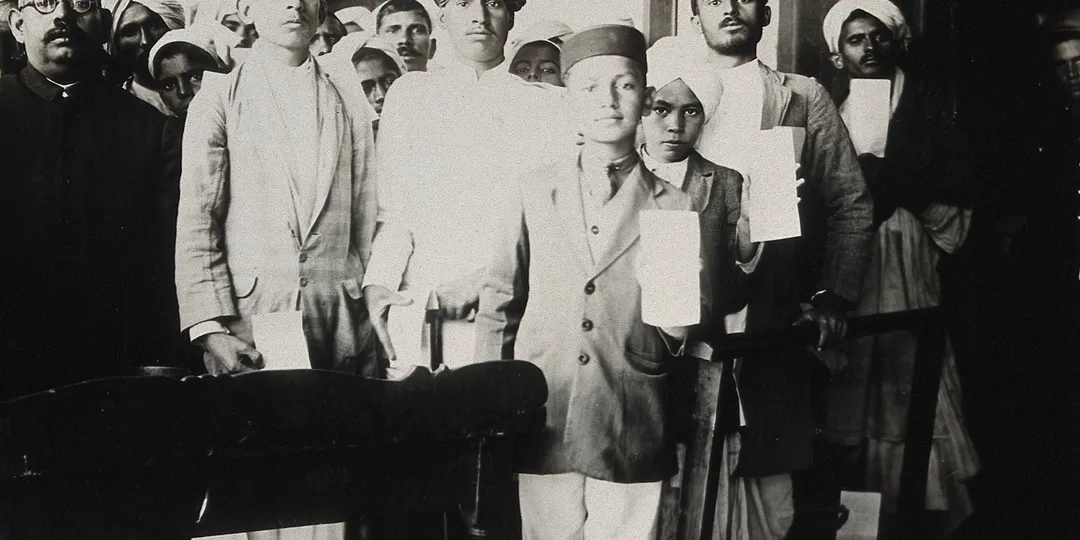
Patients await rabies inoculation at the Pasteur Institute Hospital in Kasauli around 1910. The biomedical solution is old; making it reliably reachable remains the policy problem. Photo: Wellcome Collection, CC BY 4.0.1
The Cruel Grammar of “Preventable”
Public health calls rabies preventable for an excellent reason. Dog bites and scratches account for about 99 percent of human cases. Immediate wound washing, a course of vaccine, and rabies immunoglobulin or monoclonal antibodies when indicated can stop the virus before it reaches the central nervous system. Once symptoms appear, however, rabies is virtually 100 percent fatal.2
There may be no other common disease for which the distinction between before and after is so absolute.
But the word preventable quietly shifts the unit of responsibility. It makes the fatal case sound like someone failed to take an available precaution: they did not clean the wound, did not go to a hospital, or did not return for the remaining doses. Sometimes that is descriptively true. It is not yet an explanation.
A treatment is not available merely because medical science knows how to make it. It is available when the bitten child, in that place, on that evening, can reach a facility that recognizes the exposure and has the right biological product in stock. Preventability describes a biological possibility. Policy determines its probability.
Prevention Is a Chain
The useful way to think about rabies is not as a vaccine but as a sequence of handoffs.
- Fewer infectious dogs. Sustained mass dog vaccination reduces transmission at its source. WHO calls this the most cost-effective strategy for preventing human rabies and explicitly says culling free-roaming dogs is not an effective control strategy.2
- Fewer risky contacts. Children and adults need practical knowledge about dog behaviour, bite prevention, responsible ownership, and what counts as an exposure.
- Immediate first aid. Washing the wound thoroughly with soap and water for at least fifteen minutes is part of post-exposure prophylaxis, not a folk add-on.2
- Correct classification. Touching an animal or a lick on intact skin is not the same as a bleeding bite. Category II and III exposures require vaccine; severe Category III exposure also requires immunoglobulin or monoclonal antibodies.2
- A stocked, competent facility. Vaccine without the indicated immunoglobulin is an incomplete service. A refrigerator without inventory discipline is not access.
- Course completion and follow-up. A person may have to return while losing wages, paying for transport, and navigating facilities that do not share records.
- Surveillance and response. The system must connect human exposures, suspected animal cases, vaccine use, and geographic clusters quickly enough to act.
Break any important link and the fact that rabies is “preventable” becomes cold comfort.
The Last Mile Is Not a Small Detail
An Indian review of rabies post-exposure prophylaxis describes the failure modes in unglamorous operational terms: weak forecasting, delayed procurement, stock variation between levels of care, inconsistent exposure classification, limited staff training, myths among patients, incomplete treatment courses, fragmented surveillance, and the cost of obtaining care privately.3
One multicentre survey cited in the review found free rabies immunoglobulin in only 40 percent of surveyed clinics in 2019. Other surveys found large differences in vaccine and immunoglobulin availability by facility type. The review also notes procurement lead times of three to four months and completion rates that varied widely across studies.3
These figures come from heterogeneous surveys rather than a single current national inventory, so they should not be read as today’s precise availability rate. Their value is diagnostic. They show that “go get the vaccine” compresses procurement, cold storage, clinical judgment, travel, money, and adherence into one sentence addressed to the patient.
WHO estimates about 59,000 rabies deaths globally each year but warns that documented counts differ because of under-reporting. It also describes the disease as concentrated among marginalized populations for whom human vaccine and immunoglobulin are often inaccessible or unaffordable.2 The people at greatest biological risk are often being asked to traverse the weakest service networks.
That is not a knowledge deficit. It is the predictable distribution of friction.
Stop Waiting for the Bite
Post-exposure prophylaxis is indispensable. A policy built mainly around it is still downstream.
It waits until a dog is infectious, a person is bitten, and the household successfully identifies and completes an emergency medical pathway. Every failure must then be repaired under time pressure. The victim carries the coordination burden.
Dog vaccination changes the denominator. It reduces the number of exposures that can become fatal in the first place. This is why rabies cannot be owned exclusively by either hospitals or municipal animal-control teams. Human health, veterinary services, local government, waste management, schools, laboratories, and civil society hold different parts of the same causal chain.
India’s National Centre for Disease Control already says as much. Its Rabies Free City guidelines call for continuous mass dog vaccination, access to pre- and post-exposure prophylaxis, public education, trained human- and animal-health staff, community engagement, surveillance, and city task forces that coordinate departments. The animal-health target includes at least 70 percent dog-vaccination coverage.4
The blueprint is not the missing invention. The harder task is turning a document with many responsible agencies into a service with an answerable owner.
What a Serious Policy Would Measure
Counting vaccine doses distributed is necessary and radically insufficient. A functioning city programme would be able to answer, by locality and over time:
- What share of the estimated dog population was vaccinated, and how was the denominator estimated?
- How many bite patients reached an appropriate facility promptly?
- Were vaccine and immunoglobulin available on the day they were indicated?
- How often did clinicians classify exposures correctly?
- How many patients completed the recommended regimen, and where did people drop out?
- Were suspected animal cases investigated and linked to exposed humans?
- Which neighbourhoods repeatedly produce bites, missed follow-up, or stock-outs?
This is the difference between inputs and a prevention system. A city can purchase thousands of doses while leaving coverage patchy. It can sterilize dogs without sustaining rabies immunity. It can report few human cases because surveillance is weak rather than because transmission is low.
The outcome that matters is not “activities completed.” It is a continuous, auditable chain from source control to protected patient.
Where I’d Hold This Loosely
Three cautions.
First, not every contact with a dog is an exposure. Panic can produce unnecessary treatment, cruelty toward animals, and pressure on limited supplies. Risk classification matters precisely because both undertreatment and indiscriminate treatment are failures.
Second, dog vaccination is not a substitute for post-exposure care. Coverage is never perfectly measured or perfectly maintained, and rabies can involve other mammals. A bitten person still needs prompt assessment.
Third, the most quoted Indian mortality numbers remain uncertain. Rabies is missed clinically, often confirmed only after death, and poorly reported. That uncertainty is not permission to choose the most dramatic estimate. It is itself evidence that surveillance is one of the broken links.
The central claim survives all three caveats. Rabies is preventable only in the way a bridge is crossable: not because each individual component exists somewhere, but because the components meet, hold, and carry a person all the way across.