TL;DR
High-volume medicine is not fake medicine. It makes common, predictable care affordable by standardizing work and moving patients quickly. The failure begins when the same operating model is applied to the diagnostic exception: the patient with several conditions, an atypical presentation, contradictory tests, or symptoms that only make sense over time. Diagnosis is not merely what happens inside one consultation; it is the synthesis of a longitudinal record, response to treatment, tests, referrals, and follow-up. A sane system therefore needs two connected modes: a fast lane for routine care and a depth lane with case ownership, protected reasoning time, continuity, and escalation. The mistake is not volume. It is forcing every case to remain inside it.
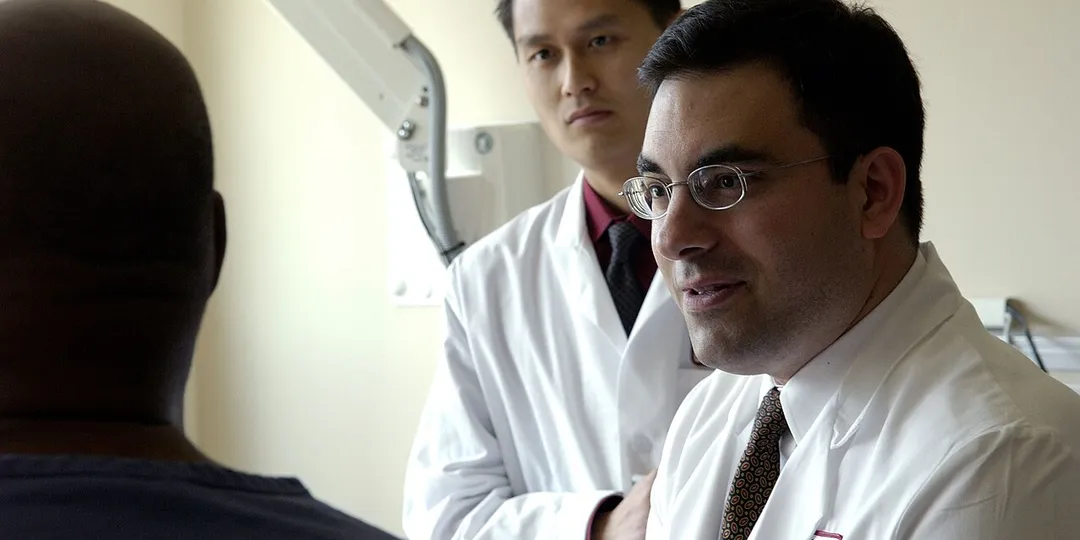
A clinical consultation with a second physician observing and taking notes. Difficult cases need a system that can slow down and integrate perspectives. Photo: U.S. National Cancer Institute, public domain.1
Cheap and Deep Are Different Achievements
Medicine is often discussed as though there were one ladder of quality. At the bottom sit crowded clinics and short visits; at the top sit long consultations, extensive testing, and famous specialists.
That picture confuses two dimensions.
One is access: can many people obtain competent treatment at a price and distance they can bear? The other is diagnostic depth: can the system recognize and resolve a case that does not fit the usual pattern?
A high-throughput clinic can be excellent on the first dimension. Standard protocols, experienced staff, limited formularies, and repeated exposure to common conditions can make routine work fast and reliable. A long, expensive appointment can still be fragmented, defensive, or clinically useless.
The real problem is architectural. A system optimized for the typical case tends to keep processing the atypical case as if one more quick episode will make it typical.
What Two Minutes Can and Cannot Do
A systematic review assembled 111 publications covering 67 countries and about 28.5 million primary-care consultations. In 18 countries representing roughly half the world’s population, reported average consultation length was five minutes or less. The Indian studies in its table reported averages around 1.5 to 2.3 minutes.2
Those numbers are memorable, which makes them dangerous. The Indian observations were old and several were rated poor or fair quality. Consultation length was measured differently across studies. A two-minute visit for a repeat prescription is not equivalent to two minutes with a patient whose unexplained weight loss has survived three prior consultations.
The review did find associations between shorter consultations and problems such as polypharmacy, antibiotic overuse, and poorer communication in some included studies. Other outcomes were mixed, and consultation length itself does not prove quality.2
The defensible claim is narrower: very short encounters sharply limit what kind of cognitive work can occur inside them. A clinician can recognize a familiar pattern, check a dangerous red flag, and start a standard treatment quickly. It is much harder to reconstruct a six-month history, reconcile conflicting reports, examine earlier reasoning, generate a serious differential diagnosis, explain uncertainty, and plan discriminating follow-up.
Time is not quality. Some forms of quality require time.
Diagnosis Happens Between Visits
The popular model of diagnosis is cinematic: the brilliant doctor notices one overlooked clue and names the disease. Real diagnostic work is often temporal.
A symptom evolves. A treatment fails. A lab result moves. A second condition changes the meaning of the first. A referral produces a finding that must be reconnected to the original complaint. The absence of expected improvement becomes evidence.
India’s National Health Systems Resource Centre describes diagnosis as a process that unfolds through initial assessment, testing, referrals, follow-up, and patient adherence. Its patient-safety material identifies workload, fragmented records, weak communication, limited access to specialists or tests, cognitive synthesis, and poor follow-up as contributors to diagnostic error. It also notes that precise Indian estimates are unavailable because reporting systems are weak.3
That last point matters. If a patient sees four clinicians and none owns the accumulating case, the system may record four reasonable encounters and one missed diagnosis. Every local action can look defensible while the longitudinal result is disastrous.
An episode model asks, “What is the most likely explanation today?” A diagnostic system must also ask, “What no longer makes sense after everything that has happened?”
The Exception Is Expensive in a Particular Way
Complexity is not the same as rarity. A common disease can present atypically. Several ordinary conditions can interact. Social circumstances can make the textbook plan impossible. The patient may be taking medicines from multiple clinicians who do not see the same list.
What makes the case expensive is the need for integration.
Integration consumes scarce resources that volume systems tend not to price or protect:
- reviewing old records rather than ordering the next test;
- comparing changes across time;
- contacting another clinician;
- holding several hypotheses without prematurely choosing one;
- explaining uncertainty and specifying what should trigger return;
- noticing that repeated “normal” visits form an abnormal pattern;
- accepting responsibility for the next step.
None of this requires every patient to receive an hour. It requires a reliable way to identify when the standard encounter has stopped being enough.
Build a Depth Lane
The answer is not to make every clinic slow. That would reduce access, increase queues, and waste specialist attention on work that protocols and primary-care teams can perform well.
A better design separates modes while keeping them connected.
Fast lane
Routine, low-uncertainty care remains standardized: common acute illnesses, stable chronic-disease follow-up, vaccinations, simple procedures, and repeat prescriptions with appropriate checks. Nurses, pharmacists, community health workers, decision support, and standing protocols can expand capacity.
Depth lane
Cases cross a threshold when they show signals such as repeated visits without improvement, unexplained deterioration, conflicting tests, several interacting conditions, diagnostic disagreement, or a clinician’s explicit uncertainty. The depth lane provides:
- one named clinician or team that owns the case;
- a concise longitudinal summary rather than a pile of documents;
- protected review time;
- access to specialist or multidisciplinary discussion;
- an explicit differential diagnosis and follow-up plan;
- feedback to the referring clinician and the patient.
The threshold should not depend only on a charismatic doctor sensing that something is unusual. The record itself can flag return visits, treatment failures, abnormal trends, and unresolved referrals.
WHO’s primary-care framework emphasizes first-contact access alongside continuity, coordination, comprehensiveness, and person-centredness. Its recent checklist is explicitly designed for a structured longitudinal primary-care visit.4 That is the balance: first contact gets the patient in; continuity and coordination stop the difficult patient from being reset to zero each time.
Continuity Is Not Sentimentality
Continuity is sometimes defended in nostalgic terms: the family doctor who knows three generations and remembers every illness. The operational value is simpler. Familiarity reduces the cost of reconstructing context and makes change visible.
A systematic review of continuity with doctors and mortality included 22 studies; 18 reported statistically significant reductions in mortality with greater continuity. The authors did not perform a meta-analysis, the studies were observational, and association does not prove that continuity itself caused the difference.5 Healthier patients or better systems may be more able to maintain stable relationships.
Still, the consistency of the association fits the mechanism. Someone who has seen the baseline is better positioned to recognize a deviation. Someone expecting to see the patient again has a stronger feedback loop on whether the plan worked.
Continuity need not mean the same individual at every visit. A stable team, usable record, named case owner, and closed referral loop can preserve much of its diagnostic value.
Where I’d Hold This Loosely
This argument can easily become an unfair indictment of clinicians working under scarcity. A doctor seeing an impossible queue does not create the queue by thinking too quickly. Nor would doubling every appointment automatically solve diagnostic error; fatigue, poor records, weak testing, bad incentives, and inadequate training would remain.
There is also a danger in romanticizing diagnostic depth. More specialists and more tests can produce incidental findings, contradictory recommendations, expense, and overtreatment. “Complex” can become a profitable label attached to ordinary uncertainty.
The depth lane therefore needs discipline: explicit questions, staged testing, evidence for escalation, and responsibility for stopping as well as starting investigations.
Volume medicine is good at moving many people through a known pathway. The exception needs someone authorized to say the pathway no longer fits—and a system prepared to do something other than send the patient through it again.