TL;DR
Article 19(2) lets the state restrict speech on eight enumerated grounds, including public order, decency, defamation and contempt of court.1 That is more restrictive than the American position, where Brandenburg (1969) protects advocacy unless it is directed to inciting imminent lawless action and likely to produce it,2 but not obviously more restrictive than Germany’s, where incitement against a group carries three months to five years.3 The divergence that actually bites is procedural. Section 66A of the IT Act was struck down in March 2015; across eleven states, 682 cases were registered under it before that date and 1,306 after, with 745 still pending in March 2021.4 On sedition, a database of cases from 2010–2021 records 13 convictions against a conviction rate it puts at 0.1%, with accused persons spending an average of 50 days in custody before trial-court bail and up to 200 before a High Court decided.5 The sanction is not the sentence. It is the file.
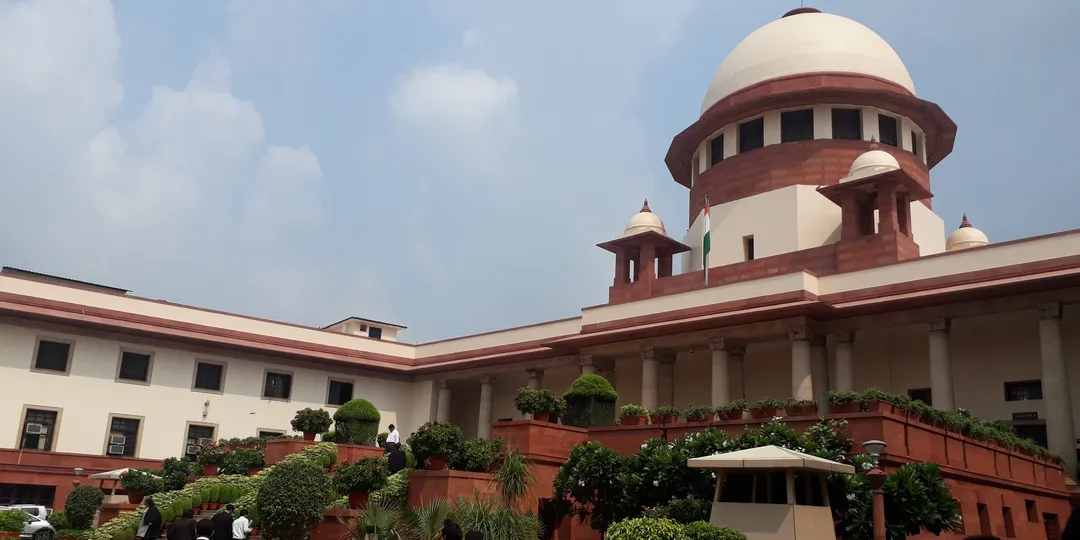
The Supreme Court of India. It struck Section 66A down in 2015, and then had to keep saying so. Photo: Pinakpani, CC BY-SA 4.0.6
The Comparison Nobody Actually Runs
Arguments about free speech in India tend to be conducted by reading the Constitution aloud and then reading the First Amendment aloud, and the conclusion is usually available before the reading starts.
It’s the wrong exercise. Constitutional text tells you what a state has authorised itself to do. It tells you very little about what the state actually does, how often, to whom, and at what cost to the person on the receiving end. Two countries with near-identical speech clauses can produce completely different lived experiences of speaking, and two countries with divergent clauses can converge.
So run the comparison properly: text first, then practice, and notice which one is doing the work.
What the Text Says
India. Article 19(1)(a) guarantees freedom of speech and expression. Article 19(2) then permits reasonable restrictions on eight enumerated grounds: sovereignty and integrity of India, security of the state, friendly relations with foreign states, public order, decency or morality, contempt of court, defamation, and incitement to an offence.1 Contempt of court was added during the drafting itself, over objections from members who worried about judicial misuse.1
The United States. The governing standard for inflammatory speech is Brandenburg v. Ohio (1969): the government cannot punish speech unless it is “directed to inciting or producing imminent lawless action” and is likely to do so.2 That test replaced the older bad-tendency and clear-and-present-danger formulations by adding a hard imminence requirement, and it remains the standard with no serious challenge since.2
Germany. Section 130 of the German Criminal Code criminalises incitement against a national, racial, religious or ethnic group, and conduct that violates the human dignity of such a group by insulting, maligning or defaming it, where the conduct is suited to disturbing the public peace. The penalty is imprisonment for between three months and five years.3
Line those up and the ranking is clear but the gaps are not where the debate assumes. The US is the outlier — no criminal defamation in practice, no group-libel offence, a demanding imminence test. India and Germany both permit criminal sanction for categories of speech that America protects. India has more enumerated grounds; Germany attaches a mandatory minimum prison term to some of its offences, which India’s Article 19(2) does not itself do.
This is the first thing worth being honest about. “India restricts speech more than a liberal democracy should” is not established by comparing India to the United States, because on this axis the United States is unusual among democracies rather than typical of them.
Where the Divergence Actually Is
Now the practice, and here the picture changes completely.
On 24 March 2015, in Shreya Singhal v Union of India, the Supreme Court struck down Section 66A of the Information Technology Act — the provision that criminalised sending “grossly offensive” or “menacing” messages by computer — as violating Article 19(1)(a).7
What happened next is the finding. A tracker built by CivicDataLab and the Internet Freedom Foundation, covering eleven states between October 2009 and February 2020, recorded 682 cases registered under Section 66A before the judgment and 1,306 after it.4 Not a residual tail: nearly twice as many prosecutions under a dead provision as under a live one, with 245 of them registered in the single year to February 2020 — five years after the section ceased to exist.4 As of March 2021, 745 such cases were still pending.4
The Supreme Court has had to intervene repeatedly. In February 2019 it directed that the judgment be circulated to all High Courts, district courts, chief secretaries and state governments to sensitise police.7 In April 2021 the People’s Union for Civil Liberties had to petition again, asking the Court to order data collection on pending cases and an advisory against fresh filings.7 The explanation offered is administrative — the judgment simply never reached the constable writing the FIR.7
Whatever the cause, note what it means. In India, a constitutional victory at the apex court is not self-executing at the police station. Striking down the text did not stop the prosecutions, because the prosecution was never really about the text.
The Sedition Numbers
Sedition makes the same point with better data.
Article 14’s database, covering 2010–2021 and built from about 1,300 legal documents, 800 media reports, 125 FIRs and over 70 interviews, tracked sedition prosecutions across India.5 The outcome figures are the striking part: of 126 trials concluded within the study window, 98 people were acquitted of all charges, 13 were acquitted of the sedition charge specifically, and 13 were convicted — which against the full set of accused the database puts at a conviction rate of 0.1%.5
A 0.1% conviction rate would normally be read as a law that isn’t working. Read it the other way. If the state’s objective were convictions, this would be a catastrophic failure rate. If the objective is the process itself, it is functioning exactly as designed — because the process is where the cost lands:
- Accused persons spent an average of 50 days in custody before obtaining bail from a trial court, and up to 200 days waiting on a High Court.5
- Trial courts rejected bail applications more often than they granted them; High Courts granted bail at roughly seven to one against rejections.5
- Time from FIR to acquittal ranged from 209 to 3,520 days — the upper end being close to a decade.5
Someone acquitted after 3,520 days has won. They have also lost nearly ten years, a passport, probably a job, and whatever they would have said in the interim.
And the legal status of the offence has been in flux throughout. In May 2022, in S.G. Vombatkere v Union of India, the Supreme Court directed that no fresh FIRs be registered under Section 124A, that no coercive steps be taken, and that pending trials and appeals be kept in abeyance while the provision’s validity was examined, with the Union government undertaking to reconsider it.8 The Bharatiya Nyaya Sanhita then replaced 124A with Section 152, covering acts endangering India’s sovereignty, unity and integrity by words, signs, electronic communication or financial means, punishable by up to seven years or life.8 Whether that is reform or relabelling is contested and now before the courts.8
The Part That Isn’t About One Party
There’s a reading of all this that makes it a story about a single national government, and the data does not support that reading cleanly.
The state-level distribution from the same database: Bihar 171 cases, Tamil Nadu 143, Uttar Pradesh 127, with Meghalaya, Mizoram and Nagaland recording none.9 Those top three were governed by different parties across the period, and Tamil Nadu — second on the list — has been run by neither of the national formations. Sedition FIRs have been filed by state police under governments of most major political persuasions, including against opponents of the party in power in that state.
That matters for the diagnosis. If speech prosecutions were mainly an ideological project of one government, the fix would be electoral. Because they are distributed across states and parties, the more plausible reading is that this is an available instrument — a low-cost, high-friction tool that any local political actor with access to a police station can use, and which almost nobody in office has an incentive to disarm.
The Process Is the Punishment
The framing here is not new, and it’s worth naming its source. Malcolm Feeley’s 1979 study of the New Haven Court of Common Pleas found that for minor offences the real cost to defendants was not the sentence but everything before it — bail, fees, lost work, wasted time — and that these costs were high enough that defendants almost universally avoided trial altogether.10 Punishment, in his formulation, was administered before guilt was determined, largely by actors other than the judge.10
Transplant that to a jurisdiction where pretrial detention is the norm rather than the exception and the mechanism amplifies enormously. NCRB’s Prison Statistics for 2022 reports that more than 75% of India’s prisoners are undertrials, in a system running at 131% of capacity.11 That is the baseline condition into which a speech FIR is filed. The question a person facing one has to answer is not “will I be convicted” — on the sedition numbers, almost certainly not — but “how many months until bail, in which court, at what cost, and how many times can this be refiled.”
Which is why the textual comparison is misleading. Germany’s Section 130 carries a mandatory minimum that India’s speech offences mostly don’t. But the German defendant’s exposure is largely the sentence, arrived at through a process with a determinate end. The Indian defendant’s exposure is largely the process, whose end is not determinate and whose conclusion is usually acquittal. Same nominal category of restriction. Entirely different thing to be on the receiving end of.
What Would Actually Change It
If the diagnosis is procedural, then textual remedies will underperform, and we have direct evidence of that: 66A was deleted from the statute book and produced twice as many prosecutions afterwards.4 Repealing a provision does not remove the instrument if the instrument is the FIR.
The interventions that follow from this diagnosis are unglamorous and mostly about default settings rather than principles. Bail as the presumptive position for speech offences, since the conviction rate makes pretrial detention hard to justify on flight-risk or evidence-tampering grounds. Limits on where a case can be filed, since the ability to open FIRs in multiple distant jurisdictions over one post multiplies the travel and lawyer cost without multiplying the alleged offence. Real consequences for registering a case under a provision that no longer exists. Published, disaggregated data on filings and outcomes, without which none of the above can be monitored — and note that every number in this piece comes from civil-society trackers and journalists reconstructing records, not from a routine official series.
None of that requires amending Article 19(2), which is convenient, because Article 19(2) is not going to be amended.
Where I’d Hold This Loosely
Three real limits.
The most-quoted finding from the sedition database — that 96% of cases against 405 people accused of criticising politicians were filed after 2014 — I have deliberately not built on, because it has a confound the headline doesn’t carry. NCRB began recording sedition separately only in 2014, court records digitised progressively over the decade, and media coverage of such cases expanded sharply in the same period. A dataset assembled from legal documents and press reports will find more of what was better recorded. The post-2014 rise may well be real and large; I don’t think this database on its own establishes its size, and the figures I have used — outcomes, bail delays, durations, state distribution — don’t depend on it.
Second, my central comparative claim is under-evidenced on one side. I’ve asserted that the Indian divergence is procedural rather than textual, but I have India’s pretrial numbers and no equivalent measurements for German or American speech defendants. It is entirely possible that a German incitement prosecution also involves substantial pretrial cost; I simply haven’t found it measured, and comparing a well-documented system to two undocumented ones is exactly the trap this piece opens by warning about. Treat the direction as argued, not demonstrated.
Third, none of this establishes that the speech being prosecuted is all worth protecting. Some of it is genuine incitement, some is targeted harassment, and a system with 0.1% convictions is failing in both directions at once — it inflicts enormous cost on people who did nothing prosecutable, and it is a poor instrument for the rare case that genuinely warrants prosecution. Those are the same defect. A process that punishes regardless of outcome is one that has stopped needing to distinguish between them.
Footnotes
-
https://www.constitutionofindia.net/articles/article-19-protection-of-certain-rights-regarding-freedom-of-speech-etc/ ↩ ↩2 ↩3
-
https://medium.com/civicdatalab/section-66a-the-zombie-on-a-hunt-2a96a68ca54d ↩ ↩2 ↩3 ↩4 ↩5
-
https://theleaflet.in/new-database-quantifies-the-abuse-of-sedition-law-in-india-between-2010-and-2021 ↩ ↩2 ↩3 ↩4 ↩5 ↩6
-
https://commons.wikimedia.org/wiki/File:Supreme_Court_of_India%2C_inside_buildings_01_%28cropped%29.jpg ↩
-
https://www.scobserver.in/journal/section-66a-the-dead-law-that-still-haunts-india/ ↩ ↩2 ↩3 ↩4
-
https://www.scobserver.in/journal/sedition-in-abeyance-but-not-in-limbo/ ↩ ↩2 ↩3
-
https://www.barandbench.com/news/28-annual-rise-in-sedition-cases-during-modi-government-regime-article-14-database ↩
-
https://en.wikipedia.org/wiki/The_Process_Is_the_Punishment ↩ ↩2
-
https://www.livelaw.in/news-updates/ncrb-releases-prison-statistics-india-report-2022-243973 ↩