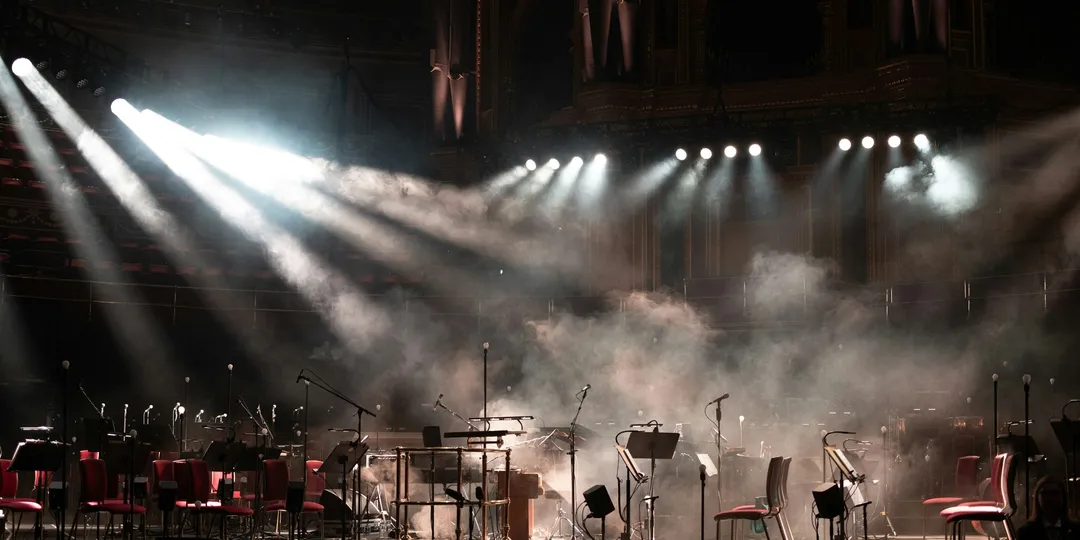
Everything required for a performance, and nothing yet to account for. Photo: Joakim Kingstrom on Unsplash.1
When TVK rallies filled grounds across Tamil Nadu, voters believed they were weighing DMK’s record against TVK’s potential. They were not. They were comparing a government to a campaign. The comparison was structurally rigged before anyone spoke.
Editor’s note, 7 August 2026: This essay was written before Tamil Nadu voted on 23 April. Its argument is preserved in that pre-election tense. A post-election note below records what changed once TVK became the government. The essay has also been revised to distinguish electoral turnover from institutional reform.
This is not a TVK problem or a DMK problem. It is a central mechanism of electoral politics: every challenger can turn the incumbent’s visible failures into a story about its own invisible virtue. But there is an equally serious mistake on the other side. Once we notice that every new government eventually acquires a shadow, it is tempting to conclude that changing governments changes nothing.
That conclusion is too cynical. Electoral turnover often creates the opening for reform. It is neither the same thing as reform nor sufficient to produce it.
The asymmetry
Every government accumulates shadow. Every campaign has only light.
A government has files, postings, transfers, tenders, FIRs, court cases, contractor relationships, district-level scandals, welfare leakages, scheme failures, police excesses, bureaucratic arrogance, and a thousand small daily compromises that surface in newspapers. It is audited every morning by people who live under it.
A campaign has slogans, rallies, promises, and a candidate’s face on a flex board. It has no postings to defend, no transfers to explain, no tenders to justify, no FIRs to answer for. Its failures have not happened yet because it has not governed yet.
So the comparison voters are invited to make is rarely government A versus government B. It is audited government versus unaudited promise. The audited side will usually look worse because audit produces a visible record while promise produces an image.
This is what insurgent campaigns exploit. Anti-corruption rhetoric makes the simplification especially powerful. A system with many points of failure is compressed into one diagnosis: bad people captured the state. Replace those people and cleanliness will return.
Sometimes the people are indeed bad. But the story is politically useful precisely because it stops there.
Tamil Nadu 2026
The DMK government had five years of governing in the file. Some of that file was real achievement and some of it was real shadow: TASMAC controversies, contractor ecosystems around major schemes, dynastic optics around the second generation, and the inevitable accumulation of district-level scandals when a party holds district-level power. None of this was imaginary, and none of it should have been excused as the unavoidable cost of government.
The AIADMK carried its own decade of shadow plus the post-Jayalalithaa succession damage, which is why it could not run the fully shadowless play even while out of power.
TVK entered the field shadowless by definition. No MLAs tested under pressure. No bureaucracy run. No police orders given. No flood handled. No budget passed. No coalition partner alienated. No scheme leaked. The party had not had the opportunity to acquire a governing shadow, which voters were invited to read as evidence that it did not have one.
This was the same structural advantage AAP held in Delhi in 2013, Modi held against Congress in 2014, Mamata Banerjee held against the Left in 2011, and NTR held in Andhra Pradesh in 1983. The honest pre-election question was not “Is TVK cleaner than DMK?” It was “What will TVK do when it inherits the same offices, discretion, contractors, police powers, and incentives?”
That question is harder because it asks imagination to work against desire. Rallies are built to make the alternative feel real while keeping its future costs abstract.
Turnover is not nothing
The asymmetry does not mean voters should keep a compromised incumbent because every challenger will disappoint. Competitive elections are themselves an institution of accountability.
A study of national elections held worldwide between 1946 and 2018 compared close victories by challengers with close victories by incumbents. Electoral turnovers improved several measures of national performance, and the authors found evidence of policy change, better governance, and lower perceived corruption after turnover.2 That is not proof that every challenger is superior. It is strong evidence against the lazy claim that alternation is merely cosmetic.
Another study, using Brazilian municipal audit reports, found that mayors who could seek re-election misappropriated 27 percent fewer resources than mayors barred from another term.3 The striking lesson is not that first-term mayors were morally better people. It is that political incentives changed conduct.
Turnover matters in at least three ways. It can punish failure. It can break the presumption that one network owns the state. And it can make the next incumbent govern under a credible threat of removal. Long tenure allows party, contractor, bureaucratic, media, and donor relationships to settle into a mutually protective equilibrium. Alternation can disturb that equilibrium even before it replaces any formal rule.
But disruption is perishable. A new coalition can inherit the old machinery, replace its beneficiaries, and build a new equilibrium around itself. Rotation prevents complete entrenchment. It does not prevent re-entrenchment.
What actually survives a change of government
“The system” is too vague to be useful. What a new government inherits has at least five layers:
- Elected leaders: ministers, legislators, mayors, and the political executive. Elections can replace these directly.
- Political networks: party officials, donors, brokers, local notables, contractors, and informal intermediaries. A victory displaces some networks but often recruits or recreates others.
- Administrative machinery: civil servants, police hierarchies, transfer practices, procurement routines, and departmental habits. These can outlast several governments.
- Institutional rules: who appoints watchdogs, how tenders are disclosed, whether audits are acted upon, how information requests work, and how conflicts of interest are policed.
- Political economy: the firms that depend on state contracts, the cost of elections, concentrated media ownership, land and licensing rents, and the incentives linking money to power.
Campaigns naturally concentrate on the first layer because it is visible, personal, and removable on election day. Governance failure often reproduces itself in the other four.
This is why a newly elected politician can be changed by the machinery faster than the politician changes the machinery. The new minister needs departmental knowledge, party finance, legislative support, cooperative officials, and rapid delivery. Each need creates dependence on an inherited network. What began as a promise to cleanse the state becomes a negotiation with the people who know how the state actually moves.
The result need not be identical to the old government. Ideology, leadership quality, competence, and discipline matter. But replacing the beneficiaries of discretion is not the same as reducing discretion.
The reform test
Punishing predecessors may be justified. It can establish consequences, recover assets, and expose conduct that incumbency concealed. But punishment is not yet reform. If anti-corruption enforcement reliably points backward at the defeated party while leaving the winner’s discretion untouched, it is at least as useful for consolidating power as for cleaning government.
Real reform imposes costs on the reformer. It creates rules the winning party would prefer its opponents to obey but agrees to obey itself:
- procurement systems that publish tenders, bidders, awards, amendments, and beneficial owners in usable form;
- political-finance rules that expose who funds parties and how campaign money moves;
- audit, vigilance, investigation, and prosecution bodies with credible operational independence;
- civil-service appointment and transfer rules that make administrative careers less dependent on partisan favour;
- workable access-to-information systems, protected whistleblowers, and time-bound action on audit findings;
- appointment processes and legislative committees that give opposition parties and civil society meaningful scrutiny rather than ceremonial presence.
These are not glamorous rally promises. They are the institutional systems, incentives, prevention mechanisms, and credible enforcement that the World Bank places at the centre of anti-corruption work.4 They also reveal another trap: passing rules is easier than implementing them. The OECD’s 2026 integrity indicators found a 19-point average gap in member countries between the strength of integrity regulations and their implementation in practice.5
The decisive question is therefore not “Did the new government announce an anti-corruption law?” It is “Did it fund the watchdog, publish the data, protect the investigator, follow the audit, and tolerate scrutiny when the finding reached its own people?”
The worst-opponent test
Voters do not need lower expectations. They need sharper ones.
The wrong expectation is that a sufficiently honest leader will make corruption disappear. The better expectation is that a government claiming reform will make honesty less dependent on the leader. Ask of every proposal:
Would I still want this rule if my worst political opponent won the next election and controlled it?
If the answer is no, it is probably a weapon, a favour, or an extension of executive discretion—not an institution.
This test also corrects the campaign-versus-government asymmetry. A challenger cannot show how it has governed a state it has never governed. It can specify which powers it will surrender, which decisions it will expose, how watchdogs will be appointed, what procurement data will become public, and what safeguards will apply when allegations reach its own party. Those commitments are not a full audit, but they are more testable than declarations of personal purity.
For voters, the mature comparison has two columns. First: does the incumbent deserve removal? Second: has the challenger proposed changes that will survive the challenger? A yes to the first does not guarantee a yes to the second. It can still justify turnover. It should not be mistaken for reform.
For the media, the same distinction supplies the missing questions. Do not ask only which ministers will be investigated. Ask which appointment powers will be constrained. Do not ask only whether corruption will end. Ask what procurement fields will be published, what deadlines will bind departments, who can remove an investigator, and whether the opposition will have standing to trigger scrutiny.
Postscript: the two-stage test has begun
Tamil Nadu has now crossed the line this essay originally described. In the 2026 Assembly election, TVK emerged as the largest party with 108 seats.6 C. Joseph Vijay was sworn in as chief minister on 10 May 2026.7
That result completed stage one: voters used alternation to disrupt an established competition and placed a new party under audit. The result matters even if TVK eventually disappoints. It demonstrated that power could move.
Stage two is harder. Every appointment, contract, police decision, budget trade-off, delivery failure, audit response, and watchdog appointment now shows whether TVK is merely occupying the inherited machinery or changing the rules by which that machinery operates. The question is no longer whether a shadowless campaign was cleaner than an audited government. It is whether the new government will build institutions strong enough to scrutinise its own shadow—and useful enough to remain when another party returns.
Democracy lets citizens remove rulers. Good governance begins when the quality of the state depends less on which ruler they choose.
Rotation prevents complete entrenchment. Institutional reform prevents the next entrenchment. A democracy needs both.
Footnotes
-
https://unsplash.com/photos/orchestra-stage-with-spotlights-and-smoke-Is6c8E2Ghzg ↩
-
https://vrollet.github.io/files/Electoral_Turnovers_published.pdf ↩
-
https://www.worldbank.org/en/topic/governance/brief/combating-corruption ↩
-
https://results.eci.gov.in/ResultAcGenMay2026/partywiseresult-S22.htm ↩
-
https://www.pib.gov.in/PressReleasePage.aspx?PRID=2259495&lang=1®=1 ↩