TL;DR
A quote where Thomas Babington Macaulay supposedly praises India’s wealth, culture, and moral character in 1835 — then plots to break its spine through English education — is fabricated. Macaulay was in Calcutta that day, not London; the real document survives and says nothing like it; and the earliest traceable print version openly hedges itself as a paraphrase.12 What he actually wrote is a matter of public record, and it makes a different, more mundane case for English than the quote pretends: not cultural warfare, but a bet that Sanskrit and Arabic learning had less to offer than Sanskrit’s own scholars would admit.3
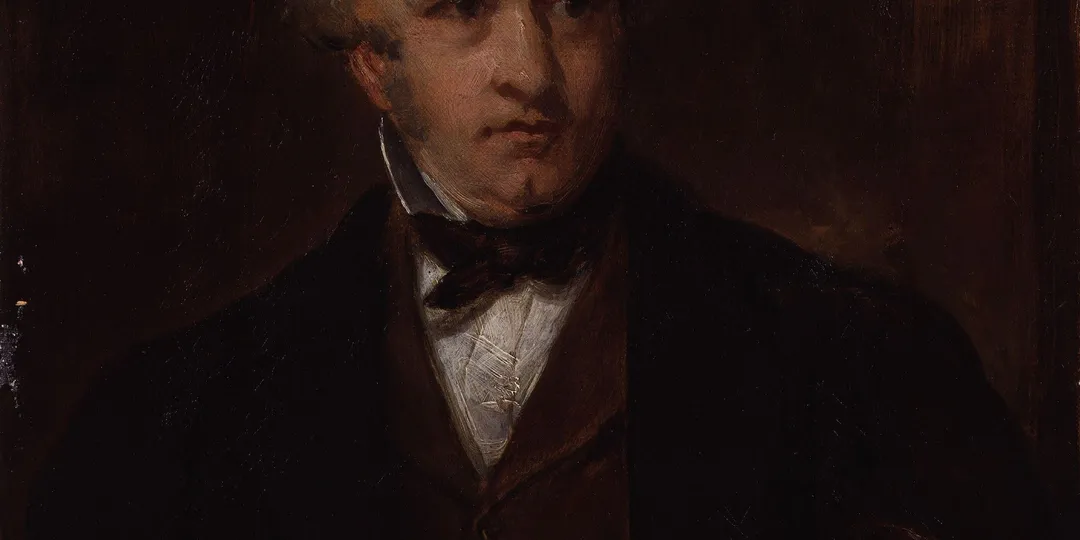
Portrait of Thomas Babington Macaulay by Sir Francis Grant, National Portrait Gallery, London — public domain.4
The Quote You’ve Probably Seen
It shows up on WhatsApp forwards, in op-eds, occasionally in Parliament. It has Macaulay addressing the British Parliament on 2 February 1835, describing a country he traveled “from one end to the other” without finding “a person who is a beggar” or “a thief,” a people of “such high moral values” that he concludes Britain will never conquer India unless it first destroys “her ancient and her spiritual education system.”1
It’s a good quote, as propaganda goes — vivid, quotable, and it flatters the reader twice: once by having a British colonial official admit India’s civilizational superiority, and again by explaining exactly why the empire supposedly had to lie about it. It has been cited by senior Indian politicians, and for a period sat on the official website of a former Indian president.2 It is also almost certainly invented.
Why It Doesn’t Hold Up
Start with geography. Macaulay left England for Calcutta in 1834 to serve on the Governor-General’s council, and did not return to Britain until 1838 — he could not have addressed Parliament in London on 2 February 1835 because he was several thousand miles away, in India, writing the very document this quote is impersonating.12
The paper trail doesn’t help the quote either. Macaulay’s real minute of that date survives in full, is easy to find, and contains none of this language.3 None of it turns up in his published letters or speeches anywhere else. The prose itself is a tell: the fabricated text carries turns of phrase and at least one outright misspelling (“selfesteem”) that don’t read like mid-Victorian official prose, and its logic has a hole in it too — a colonial administrator touring British India in the 1830s and reporting zero beggars, zero thieves, at a time when famine and the well-documented drain of wealth from India were already underway, asks readers to believe something the historical record flatly contradicts.12
Where It Actually Came From
The earliest version researchers have been able to trace back appears in The Awakening Ray, a publication of the Gnostic Centre, and was reprinted by the magazine Niti in 2002 — not in any Macaulay archive, not in Hansard, not in a biography.2 Tellingly, that earliest version introduces the quote with the qualifier “his words were to the effect” — a phrase that openly signals paraphrase, not transcription. Somewhere in the retelling between then and the version now circulating, that hedge quietly disappeared, and a “roughly this is what he might have meant” turned into a direct quotation with a date and a venue attached.2
The Indologist Michel Danino has laid out the case against the quote’s authenticity in detail, and the author N.S. Rajaram — sometimes named as the source — has himself denied writing it, saying he used a different, genuine Macaulay line about English schools instead.2 None of that stopped its spread: it has been repeated by L.K. Advani, and for a time appeared on A. P. J. Abdul Kalam’s presidential website, which is about as much institutional credibility as an unsourced quote can accidentally acquire.2
What He Actually Wrote
Here’s the part that tends to get lost once a story becomes “did Macaulay really say that”: his real Minute on Indian Education, dated 2 February 1835, is a public document, and it is not exculpatory. Arguing for English over Sanskrit and Arabic as the language of instruction, he wrote plainly:
“I have never found one among them who could deny that a single shelf of a good European library was worth the whole native literature of India and Arabia.”3
He went further, comparing the two civilizations’ output “in every branch of physical or moral philosophy” and calling the gap “absolutely immeasurable.”3 And he was explicit that the goal was never to educate the Indian population broadly, but to produce a narrow, useful layer of go-betweens:
“We must at present do our best to form a class who may be interpreters between us and the millions whom we govern — a class of persons Indian in blood and colour, but English in tastes, in opinions, in morals and in intellect.”3
That’s the real Macaulay: not a man secretly impressed by India who chose to sabotage it, but one openly dismissive of its scholarship, arguing for a school system explicitly designed to manufacture cultural intermediaries loyal to British taste. The fabricated quote makes him a calculating villain hiding admiration. The real document doesn’t need to hide anything — it states the condescension outright, footnoted and all, which is arguably a harder thing to sit with than a hoax.
It Wasn’t Simply Britain vs. India
The other thing the fake quote flattens is that this wasn’t a two-sided fight between a colonizer and a colonized civilization. Twelve years before Macaulay’s Minute, Raja Rammohun Roy — a Bengali reformer now remembered as a founding figure of Indian modernity — wrote to Lord Amherst opposing the very idea of funding a new Sanskrit college in Calcutta, on grounds that had nothing to do with pleasing the British.5 He argued that Sanskrit pandit learning would “load the minds of youth with grammatical niceties and metaphysical distinctions of little or no practical use,” and pushed instead for government money to go toward European instructors teaching mathematics, chemistry, and natural philosophy.5
Roy wasn’t arguing for English because he thought Indians were inferior; he was arguing against a specific, entrenched, pandit-controlled curriculum he thought was failing Indian students on its own terms, and for the same modern sciences he wanted taught in Bengali and other Indian languages too. Macaulay’s Minute arrived a decade later, aimed at a different target with a very different, openly hierarchical rationale — but the debate over what Indian students should actually be taught didn’t start with the British side of the table, and Roy’s letter is the paper trail that proves it.5
Why the Fake Version Won Anyway
None of this is a mystery once you notice what job each version of the story is doing. The real Minute is a colonial administrator’s cost-benefit case for a curriculum, buried in 19th-century prose, and its most damning lines require you to already care about historiography to go looking for them. The fake quote is a five-sentence morality play with a villain, a motive, and a twist — tailor-made to be forwarded, memorized, and dropped into a debate. It doesn’t need Macaulay’s actual document to do its work, which is exactly why the hedge (“his words were to the effect”) fell off so easily on the way to becoming gospel: nobody forwarding it needed it to be literally true, only satisfying.
The irony worth sitting with is that the truth was already damning enough to make the fabrication unnecessary. You don’t need Macaulay to have secretly admired India in order to indict the project he ran — his own words, on the record, in a document that still exists, do that on their own.
Footnotes
-
https://www.thefridaytimes.com/13-Jul-2018/the-infamous-macaulay-speech-that-never-was ↩ ↩2 ↩3 ↩4
-
https://satyameva-jayate.org/2007/06/26/clearing-the-dust-off-macaulays-quote/ ↩ ↩2 ↩3 ↩4 ↩5 ↩6 ↩7 ↩8
-
https://franpritchett.com/00generallinks/macaulay/txt_minute_education_1835.html ↩ ↩2 ↩3 ↩4 ↩5
-
https://commons.wikimedia.org/wiki/File:Thomas_Babington_Macaulay,_Baron_Macaulay_by_Sir_Francis_Grant.jpg ↩
-
https://en.wikisource.org/wiki/The_English_Works_of_Raja_Rammohun_Roy/Volume_II/A_Letter_on_English_Education ↩ ↩2 ↩3