TL;DR
India’s food economy is often described as if it faced a binary choice: tolerate fragmented, informal supply chains or consolidate production into large industrial firms. That is the wrong unit of analysis. Farms can remain small while testing, chilling, packhouses, transport, processing, finance, and market intelligence are pooled at larger scales. The best architecture is neither romantic localism nor consolidation by default. It chooses scale function by function, puts first-mile infrastructure near the producer, and gives farmers enough collective power to use the network rather than merely supply it.
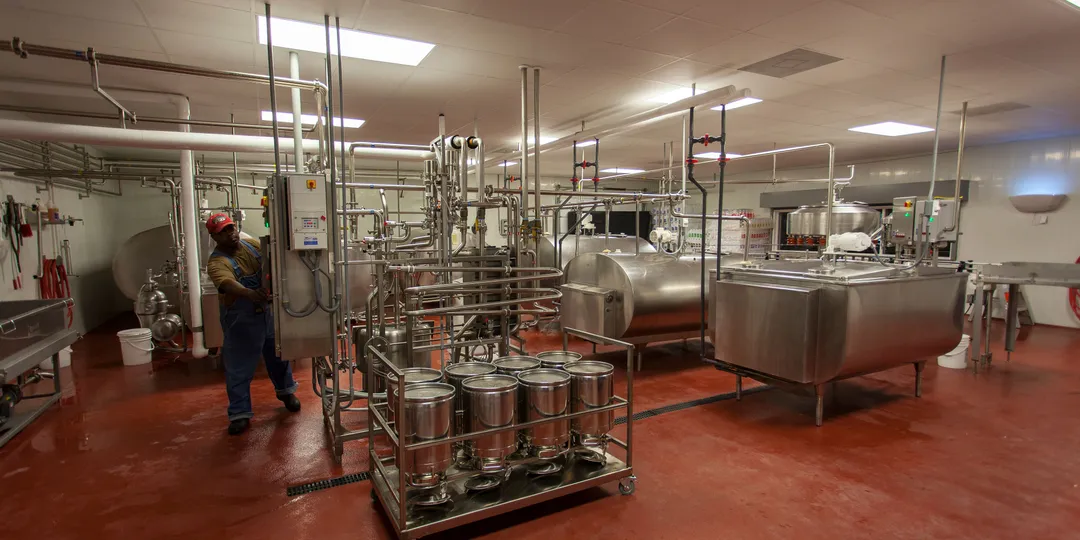
Modern dairy equipment represents only one layer of a food network. The harder design problem is connecting it to dispersed producers without stripping them of ownership. Photo: Mark Stebnicki on Pexels.1
The False Choice
Industrial food systems are good at standardization. A large processor can impose testing protocols, maintain temperature, trace batches, negotiate freight, and spread the cost of specialist staff over enormous volumes. Those capabilities matter. Raw milk does not become microbiologically safe because its producer is small, and a local tomato does not acquire a cold chain through cultural authenticity.
But concentration creates its own vulnerabilities. Aggregation can enlarge the blast radius of contamination, turn farmers into price-taking suppliers, and make an entire region dependent on a few processors or distribution channels. Efficiency and resilience are related, but they are not identical.
India should be unusually suspicious of treating consolidation as the definition of modernization. In the 2015–16 Agriculture Census, marginal holdings made up 68.45 percent of all operational holdings and small holdings another 17.62 percent—more than 86 percent combined.2 Whatever the merits of larger farms in particular crops or regions, a development strategy premised on rapidly replacing that structure would impose immense social and political costs.
The useful question is not, Should Indian agriculture be local or industrial? It is: Which functions need scale, which need proximity, and which must remain under producer control?
Production and Infrastructure Need Not Share a Scale
A two-hectare farm can be too small to own a refrigerated truck, a residue-testing laboratory, a packhouse, or a professional sales team. It does not follow that the farm is too small to grow vegetables efficiently.
The missing concept is shared infrastructure.
Imagine 200 vegetable growers within a short radius. Each keeps control of land and cropping decisions. A jointly used packhouse provides shade, sorting, grading, pre-cooling, reusable crates, basic testing, traceability, and access to scheduled refrigerated transport. A regional team consolidates orders without consolidating ownership. Produce that can be sold nearby moves quickly with little refrigeration; produce travelling farther enters the cold chain.
That is not the absence of industry. It is industry placed around production rather than substituted for it.
India’s current cold-chain scheme implicitly recognizes this architecture. The Ministry of Food Processing Industries defines an integrated chain from farm gate to consumer and includes farm-level pre-cooling, weighing, sorting, grading, packing, multi-temperature storage, mobile cooling, and refrigerated vehicles—not simply large warehouses.3
The distinction matters because a cold store at the end of a broken route is not a cold chain.
The First Mile Is the System
India’s best-known cold-chain gap study is old enough that its numbers should not be mistaken for a current inventory. Yet its topology remains revealing. Using 2014-era data, the National Centre for Cold-chain Development estimated a need for 70,080 packhouses against 249 created, and 61,826 refrigerated vehicles against about 9,000. The estimated shortfall in bulk cold-storage capacity was much smaller by comparison.4
Those estimates depended on crop, production, and operating assumptions that can be debated. Their enduring lesson is not the exact count. It is that capacity at one node cannot compensate for missing connections.
A modern packhouse belongs close to the farm because heat must be removed early. Sorting and grading allow different lots to reach different markets. Some produce should go fresh to nearby buyers without energy-intensive cooling; some needs pre-cooling and refrigerated movement; some should be processed. The route is a decision, not a doctrine.
Milk makes the same point more sharply. The useful chain is not merely a large dairy plant. It is:
producer → prompt quality testing → village collection → rapid chilling → regional processing → reliable distribution.
The National Dairy Development Board’s 2024–25 report recorded roughly 245,000 dairy cooperative societies and 16.5 million producer members. It also reported substantial installed capacity in bulk milk coolers, chilling, and dairy plants.5 These figures do not prove that every cooperative works well. They demonstrate that decentralized production and technically sophisticated aggregation are compatible at national scale.
Amul Is an Architecture, Not a Magic Word
The dairy cooperative is often invoked as if the word cooperative itself solves incentives, quality, and power. It does not.
NDDB’s recent account of its work around Varanasi reports that, between 2021–22 and 2024–25, participating village societies more than doubled, active milk pourers rose from 6,400 to 17,350, and daily procurement increased almost tenfold. The intervention added testing equipment, collection systems, and bulk milk coolers.5 This is a program report, not a randomized evaluation; favorable changes may reflect management effort, demand, prices, or other local conditions. Still, it shows what the architecture tries to do: bring quality measurement and chilling to the producer rather than require the producer to become an industrial corporation.
The harder evidence concerns incentives inside the collective. In a randomized experiment among dairy cooperatives in Karnataka, modest group incentives for milk cleanliness reduced contamination and raised the share suitable for higher-value processing. Yet nearly a third of managers declined the incentive when the payment would be publicly observed, and the researchers found that management and social dynamics mattered to implementation.6
The lesson is not merely “pay for quality.” A sensor cannot decide whether a manager will use it honestly. A cooler cannot prevent favoritism in procurement. A digital ledger cannot supply working capital. Infrastructure has a social operating system.
Reviews of farmer producer organizations reach the same sober conclusion. Collective organizations can improve market access, services, and logistics because they make otherwise expensive functions economical. But benefits vary, and weak management, inadequate working capital, poor business planning, and dependence on grants can leave organizations nominally alive and commercially ineffective.78
The alternative to corporate concentration is not a signboard with FPO painted on it. It is competent, accountable intermediate institutions.
Choose Scale by Function
A sensible food network would not force every activity into the village. It would assign each function to the smallest scale that can perform it reliably.
- Farm or household scale: cultivation choices, husbandry, on-farm hygiene, harvest timing, and much primary ownership.
- Cluster scale: collection, testing, sorting, grading, pre-cooling, crates, basic cold rooms, and extension services.
- Regional scale: specialized laboratories, pasteurization, slaughter and veterinary inspection, larger processing, finance, refrigerated transport pools, and professional market access.
- State or national scale: standards, interoperable traceability, outbreak surveillance, infrastructure planning, competition policy, and research.
This is a design principle, not a permanent map. Dense milk routes may justify village bulk coolers. A low-volume horticultural cluster may share mobile pre-cooling. Some products benefit from national distribution; others should never travel far enough to require it.
Scale should answer the biological and economic problem at hand. It should not serve as a proxy for modernity.
Cold Is Not Free
Cold chains reduce spoilage and can improve safety, but expanding them is not an environmental free lunch. Refrigeration uses electricity; transport uses energy; refrigerants can have powerful warming effects when they leak. The UN Environment Programme estimates that food cold chains account for about 4 percent of global greenhouse-gas emissions when both refrigeration and losses caused by inadequate refrigeration are included.9
That apparent contradiction is exactly why system design matters. The objective should not be “maximize refrigeration.” It should be minimize total loss, risk, energy, and avoidable processing while preserving farmer income and food quality.
That could mean solar-assisted pre-cooling where loads and climate justify it, low-global-warming-potential refrigerants, efficient route planning, insulated crates, equipment maintenance, and rapid local sale for food that does not need long-distance travel. Sometimes the greenest cold-chain decision is not to chill. Sometimes failing to chill wastes the entire harvest and all the water, fertilizer, land, and labor embodied in it.
Local and cold are tools, not moral categories.
Modernization Must Include Bargaining Power
Infrastructure can make a supply chain more efficient while leaving its producers poorer. A private packhouse may reduce loss yet capture most of the gain through fees or monopsony purchasing. A traceability system can protect consumers while becoming a surveillance system that excludes small suppliers. A contract can guarantee purchase while moving weather, quality, and rejection risk down to the farmer.
So ownership and governance are part of engineering.
Useful tests include:
- Who owns the asset? Farmer members, a municipality, a private logistics firm, or a processor?
- Who sets access and pricing? Can competing buyers use the facility, or does it lock farmers to one purchaser?
- Who sees the quality data? Can a farmer contest a test and compare results across buyers?
- Who bears downtime and spoilage risk? A cooler that fails at night can erase a day’s income.
- Who captures the higher-value market? Does improved quality raise the farm-gate price or only the processor’s margin?
The answers need not always favor cooperative ownership. A well-regulated private service can outperform a badly governed cooperative. Public assets can be captured too. The aim is contestable access, transparent measurement, operational competence, and a fair share of the gains—not fidelity to a single legal form.
Industrialize the Capability
India’s decentralized food economy contains real weaknesses: uneven hygiene, thin testing, fragmented transport, poor bargaining power, and large first-mile gaps. Pretending those are charming features of local life would sacrifice farmers and consumers to nostalgia.
But replacing dispersed producers with concentrated ownership is not the only way to obtain standards, science, and logistics. India can industrialize capabilities without industrializing every farm: precision at the collection point, cold where biology requires it, processing at regional scale, interoperable information, and collective bargaining strong enough to keep producers from becoming disposable inputs.
The farmer need not own every machine. The farmer should not have to disappear for the machine to work.
Footnotes
-
https://www.pexels.com/photo/milk-processing-in-a-factory-2889347/ ↩
-
https://sansad.in/getFile/loksabhaquestions/annex/179/AU1558.pdf?source=pqals ↩
-
https://nccd.gov.in/uploads/All_India_Cold_Chain_Infrastructure_2015_5da1279baa.pdf ↩
-
https://www.nddb.coop/sites/default/files/pdfs/NDDB_AR_2024_25_Eng.pdf ↩ ↩2
-
https://udspace.udel.edu/server/api/core/bitstreams/5a220fc9-96d2-4800-b9de-0b938758ad61/content ↩
-
https://www.unep.org/resources/report/sustainable-food-cold-chains-opportunities-challenges-and-way-forward ↩