TL;DR
The case for NEET is that everyone writes the same paper. Tamil Nadu commissioned a committee under Justice A.K. Rajan to measure what the same paper produced, and the numbers are not subtle. The state-board share of medical admissions fell from 95% before NEET to 64.27% by 2020–21, while CBSE students went from 0% of government medical college seats to 26.83%.1 Tamil-medium students collapsed from 19.79% of admissions in 2010 to 1.6% by 2017 — 456 students down to 56.2 And the share of admitted students who were repeaters rose from 12.47% to 71.42%.1 That last number is the argument: an exam that mostly admits people who have taken a year or more out to prepare for it full-time is measuring, among other things, who can afford to do that. Uniformity is a property of the procedure. Fairness is a property of everything upstream of it.
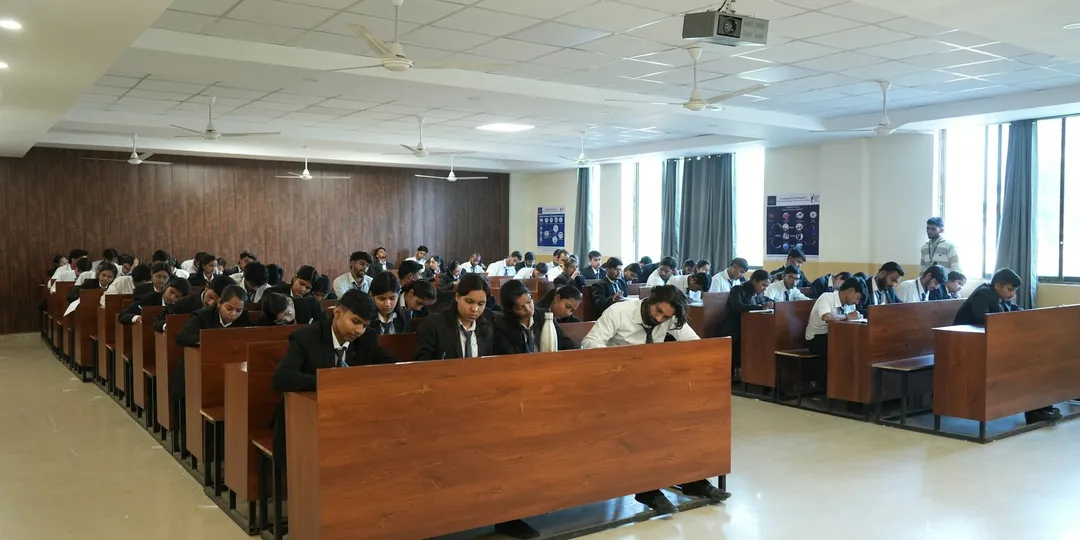
A lecture hall. Same room, same paper, same clock — and none of that is what the argument is actually about. Photo: Vishnu Mehra on Unsplash.3
The Claim Being Made
The defence of a single national entrance exam is genuinely appealing, and it should be stated at its strongest before it is examined.
Before NEET, medical admissions in India ran through a patchwork of state and institutional exams, and a large private sector in which seats were, in practice, sold. The reform was proposed to bring uniformity to admission standards and to curb malpractice in private medical colleges, where the dominant concerns were capitation fees and opaque, donation-based admission.4 That was a real problem, and anyone arguing against NEET has to say what happens to it.
The claim is procedural: one syllabus, one paper, one clock, one ranked list. Nobody’s uncle can move you up it. Whatever else it does, it removes discretion — and discretion was where the money was.
What the Same Paper Produced
Tamil Nadu took the unusual step of measuring the result. In 2021 the state constituted a committee under Justice A.K. Rajan, which produced a 165-page report and drew 86,342 public submissions — 65,007 opposed to NEET, 18,966 in favour.1
Read the three falling lines together. The share of admissions going to students from the Tamil Nadu state board fell from 95% to 64.27%. Students from rural areas fell from roughly 61% to 50%. Students educated in Tamil medium fell from 19.79% to 1.6% — in absolute terms, from 456 students a year to 56.12 Over the same period, students from households earning under ₹2.5 lakh a year fell from 41% of admissions to 36%.2
Where did those seats go? Partly to a different board: CBSE students went from 0% of government medical college seats in 2015–16 to 26.83% in 2020–21, and from 0.07% to 12.01% in self-financed colleges.1 NEET is written against the NCERT syllabus. A student who spent two years on the Tamil Nadu state syllabus is not sitting the same exam as a student who spent two years on the syllabus the exam was written from — not in any sense that matters.
The Repeater Number Is the Whole Argument
The rising line is the one to sit with.
In 2016–17, repeaters — candidates who had already sat the exam at least once — were 12.47% of those admitted. By 2020–21 they were 71.42%.1 The committee also found that around 99% of students admitted in 2019–20 had been through coaching.2 Tamil Nadu’s coaching industry was valued at ₹5,750 crore, with some 400 new centres opening after 2017.1
Put those together and the mechanism is visible. A school-leaver sitting NEET straight out of Class 12 is competing, in a single ranked list, against people with an extra full year of nothing but exam preparation. Taking that year requires the ability to not earn, not work, and pay for coaching. It is a purchasable input, and it has become the modal path in.
This is why “everyone writes the same paper” does so little work. The paper is the last four hours of a process that was unequal for two years before anyone entered the hall. Standardising the measurement does not standardise the thing being measured — it just moves all the variance upstream, where it is harder to see and impossible to appeal.
Does the Score Predict Anything?
If NEET rank tracked medical ability closely, the access argument would at least be trading fairness against quality. The evidence for that trade is thinner than you’d expect.
A retrospective study of all 150 students in the 2017–18 first-year MBBS cohort at a private college in Puducherry compared NEET score bands against first-year examination outcomes. NEET score showed no significant association with passing (p = 0.997).5 The variable that was significant was the school board: state-board students passed at 98.4%, CBSE students at 82.6% (p = 0.005).5
That is one small single-institution cohort and it cannot bear much weight — 150 students at one college is a finding to be curious about, not to legislate from. But it points at a specific gap in the public argument: the case for NEET rests on it identifying merit, and the predictive-validity evidence for that in the Indian context is scarce. An exam can be a fair sorting device or a good predictor. It is usually assumed to be both, and here it has been demonstrated to be neither.
Centralisation Concentrates the Failure
The other claim for a national exam is integrity — one administrator, one standard, less room for local corruption. 2024 tested that.
The Supreme Court, hearing challenges to NEET-UG 2024, declined to cancel the exam, holding that it was “not possible to come to the conclusion that results of the examination stand vitiated or that there was a systemic breach to the sanctity of the exam.”6 That finding should be stated precisely, because it cuts against the more excitable version of the criticism: the Court examined the question and found the leak was not shown to be systemic.
But the underlying facts are still instructive. The CBI found that 155 students had accessed leaked papers, of whom 32 were identified; the leak ran from Hazaribagh to Patna. Separately, wrong question papers were distributed at 12 centres, largely in Jhajjar, through what was described as human error by centre superintendents. The Court approved a seven-member committee under former ISRO chair K. Radhakrishnan to strengthen exam administration.6
Decentralised admissions distribute the risk of corruption; a national exam concentrates it. Neither is obviously safer. What is different is the blast radius: a compromised state exam damages one state’s cohort, and a compromised national exam puts every applicant in the country into the same court case.
What This Does and Doesn’t Establish
It does not establish that NEET should be abolished. The Rajan Committee recommended exactly that — eliminate NEET and admit on Higher Secondary marks, normalised across boards2 — and that recommendation carries a cost the report is lighter on than it should be. Board-mark inflation is real and varies by state, and returning admissions to states returns discretion to the private colleges that were selling seats. Nobody has shown that capitation-fee corruption was solved rather than displaced, but nobody has shown it would stay solved either.4
What the evidence does establish is narrower and harder to argue with: the same paper did not produce the same chance. A procedure can be perfectly uniform and still select overwhelmingly for a resource — in this case, a purchasable extra year of full-time preparation — that has nothing to do with the ability being claimed.
The useful question is therefore not “is the exam identical for everyone,” which is trivially yes and tells you nothing. It is: what does the exam actually select for, who can buy that thing, and does it predict the outcome we care about? On Tamil Nadu’s own numbers, the answers are coached repetition, households above a certain income, and not demonstrably.
Where I’d Hold This Loosely
Three real limits.
The Rajan Committee was commissioned by a state government with a declared position against NEET, and its 86,342 submissions were self-selected rather than sampled. Neither fact makes the administrative admission data wrong — board-wise and medium-wise intake figures are counted, not surveyed — but the framing and the public-opinion component should be read as advocacy with data attached, not as a neutral audit.
Second, the composition shift is not, by itself, proof of unfairness. If the pre-NEET Tamil Nadu system had been systematically over-admitting weaker candidates, some correction would be expected and desirable. The reason I don’t think that explains it is the repeater number and the coaching share — those describe a mechanism that has no plausible connection to medical aptitude. But the alternative reading exists and I can’t rule it out from these figures alone.
Third, this is one state. Tamil Nadu had an unusually well-developed state-board pathway into medicine and unusually high pre-NEET rural intake, so it had the most to lose from a switch to a national NCERT-based exam. What NEET did in Tamil Nadu is not automatically what it did in Bihar or Maharashtra, and I have not seen comparable state-commissioned data from anywhere else. That absence is itself worth noticing.
Footnotes
-
https://www.thequint.com/news/india/10-takeaways-from-tamil-nadus-a-k-rajan-report-on-neets-socio-economic-bias ↩ ↩2 ↩3 ↩4 ↩5 ↩6 ↩7
-
https://sabrangindia.in/abolish-discriminatory-and-imbalanced-neet-exam-justice-a-k-rajan-committee-2021/ ↩ ↩2 ↩3 ↩4 ↩5
-
https://unsplash.com/photos/students-attending-a-lecture-in-a-modern-classroom-v3P_spLsOH0 ↩
-
https://www.newslaundry.com/2026/07/30/can-india-scrap-neet-without-reviving-capitation-fee-yes-heres-how ↩ ↩2
-
https://www.scobserver.in/journal/supreme-court-refuses-to-cancel-2024-neet-ug-exam-due-to-insufficient-evidence-of-systemic-leak/ ↩ ↩2